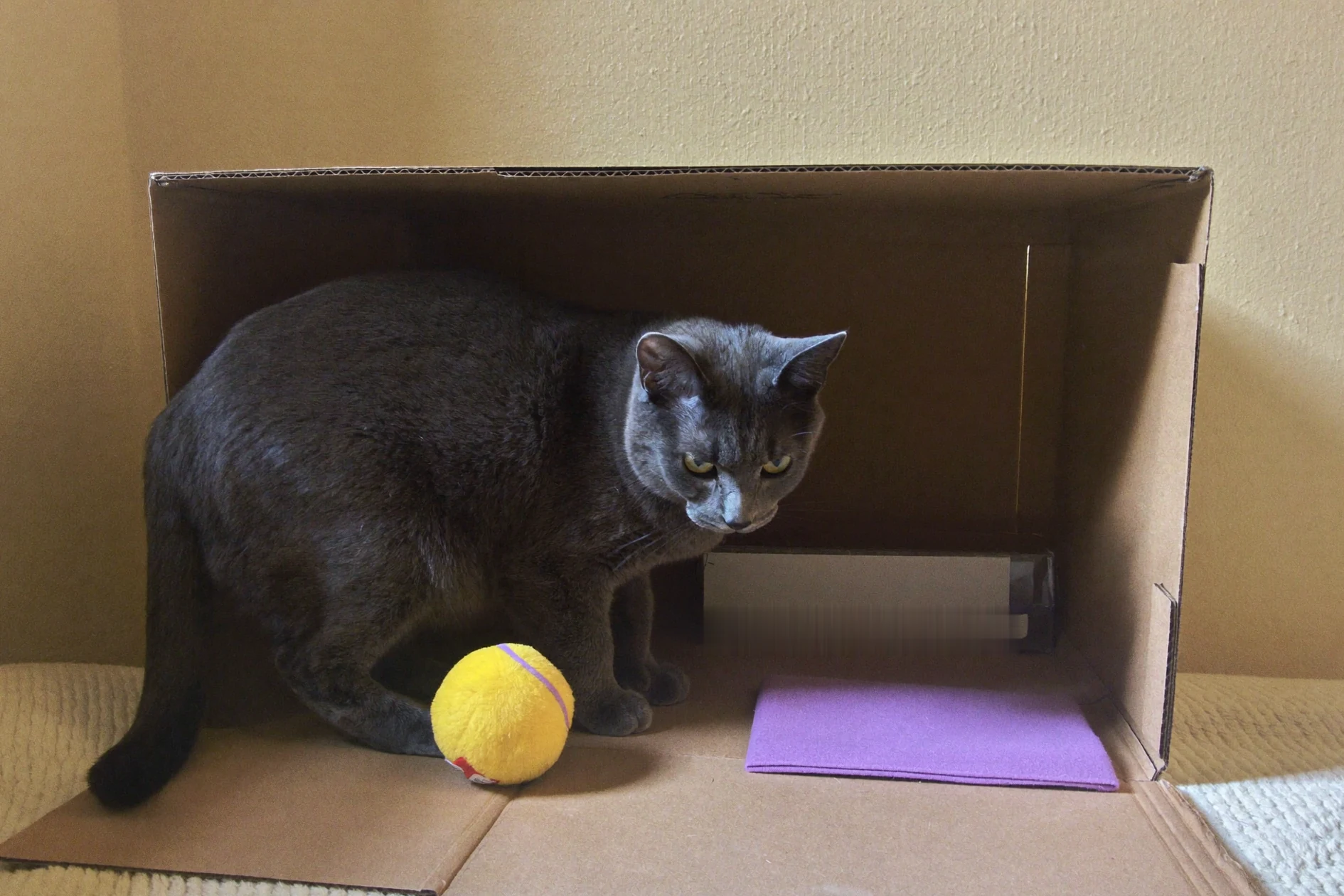
The best cat toys for anxious cats are quiet, predictable, easy to control, and simple to leave. Start with a slow ground-level wand, a shallow food puzzle, a large soft kicker, a stable enclosed ball track, or a familiar toy that already carries your cat’s scent. Introduce one option at a time, let the cat approach voluntarily, and stop before play shifts from curious to tense.
A toy can support a calmer routine, provide an appropriate outlet for hunting behavior, and help a cat build confidence through small successful choices. It cannot diagnose anxiety, remove a household stressor, or treat pain or illness. If hiding, appetite, litter-box use, grooming, sleep, movement, or social behavior has changed, begin with a veterinary conversation—not a louder toy.
This guide is for owners who want something more useful than a list of products labeled “calming.” It explains how to match a toy to your cat’s response, introduce it without pressure, build a repeatable play routine, and keep rough play safe.
Best cat toys for anxious cats at a glance
| Toy type | Why it can work | Calm setup | Main caution |
|---|---|---|---|
| Fabric wand lure | You control speed, distance, and pauses | Drag slowly away at floor level; offer frequent catches | Supervise and store the cord, lure, and wand after play |
| Shallow food puzzle | Rewards sniffing, searching, and small choices | Leave food partly exposed and use a familiar meal | Count food in the daily diet; do not make hunger part of the challenge |
| Large fabric kicker | Gives teeth and hind feet a stationary target | Place it nearby without touching the cat with it | Inspect seams and filling before and after forceful play |
| Enclosed ball track | Moves only when the cat chooses to bat it | Secure it on a nonslip surface near—but not inside—a safe area | Check for cracks, loose caps, claw traps, and detachable parts |
| Oversized quiet ball | Supports brief chase or paw play without a motor | Roll gently across a rug in a clear room | Avoid foam, loose fibers, external bells, and swallowable sizes |
| Familiar comfort toy | Known scent and texture may be less threatening than novelty | Keep it in a chosen resting area if the cat already seeks it out | Do not assume a plush toy is soothing; follow the cat’s response |
The joint AAFP/ISFM Feline Environmental Needs Guidelines describe play and predatory behavior as one of five pillars of a healthy feline environment. They recommend opportunities to search, chase, pounce, catch, manipulate, and forage, while giving separate resources and individual play in multi-cat homes. That framework is more reliable than expecting one electronic toy to “switch off” anxiety.

First, work out what “anxious” looks like for your cat
Anxiety is not simply low interest in toys. A cautious cat may watch from a doorway for several minutes and then play comfortably. A frightened or distressed cat may freeze, crouch low, scan the room, startle easily, hide, flee, or use hissing and swatting to create distance. Some cats become restless or vocal; others become unusually still.
Compare the behavior with your cat’s normal baseline. The AAHA list of common anxiety and distress signs includes changes in activity, hiding, escape attempts, hypervigilance, altered eating or drinking, vocalization, and increased or decreased grooming. One sign in one situation is not a diagnosis; a pattern, intensity, recovery time, and change from normal are what make the observation useful.
Take a 24-hour baseline before buying anything
- Trigger: what happened just before the response—a visitor, appliance, outside cat, household cat, departure, movement, touch, or no obvious event?
- Distance: how far does your cat move away, and is there a clear route to a safe place?
- Body: are the muscles loose or tense; are the ears neutral or flattened; is the tail still, tucked, or thrashing?
- Daily functions: are eating, drinking, toileting, grooming, sleeping, and movement normal?
- Recovery: does the cat return to normal within minutes, or remain withdrawn or alert long after the event?
- Play preference: does the cat watch, stalk, sniff, bat, chase, grip, kick, or ignore each kind of movement?
Record short video from a respectful distance when it is safe. Do not recreate a frightening event for the camera. A simple log helps your veterinarian separate a situational response from pain, illness, inter-cat tension, or a longer behavior problem.
Do not mistake pain or illness for anxiety
Hiding, irritability, reduced play, overgrooming, and litter-box changes can occur with both distress and medical problems. Cornell’s Feline Health Center notes in its guide to excessive licking in cats that medical causes should be ruled out before overgrooming is treated as stress-related. The same caution belongs here: toys are an enrichment tool, not a diagnostic test.
Choose the toy by control, not by the word “calming”
A useful anxiety-sensitive toy gives the cat control over four things: whether to approach, when movement begins, how intense the interaction becomes, and when to leave. Packaging cannot guarantee that. One cat may find a purring plush comforting; another may avoid the unfamiliar sound. One may enjoy a motorized ball; another may stay on alert because its direction is unpredictable.
For a cat who startles at sound
Begin with silent, human-controlled movement: a broad fabric lure on a rug, an oversized felt ball, a cardboard hide with a toy peeking around the edge, or a stationary kicker. Skip crinkle fabric, chirping modules, hard balls on tile, loose bells, and motors until you know the cat’s sound tolerance. Our quiet cat toys guide compares materials and setups for noise-sensitive homes.
For a cat who watches but will not chase
Watching is information, not failure. Place a simple lure at the edge of the cat’s usable space and make one small movement away, then pause. Try partially hiding it behind a box rather than waving it toward the cat’s face. A head turn, forward whiskers, sniff, weight shift, or single paw reach can be the whole first session.
For a cat who prefers food
Use a shallow puzzle with a few pieces of the cat’s regular measured meal visible and easy to remove. Let the first touch succeed. Once the cat approaches comfortably on several occasions, cover one compartment or move a piece slightly farther—not both. Food puzzles should add choice and searching, not frustration. Cats on a prescription diet, with food allergies, or with appetite or weight changes need a veterinarian-approved plan.
For a cat who bites and bunny-kicks hard
Offer a large, simple kicker that is comfortable to grip and too large to swallow. Favor reinforced seams, a dense washable outer fabric, secure filling, and few attachments. “Anxious” does not mean physically gentle: some cats redirect arousal into intense grabbing and kicking. Choose for the bite style you actually see, and read our durable cat toy guide for construction and failure-point checks.
For a cat who wants to initiate play alone
A captive ball track, stable puzzle, large simple kicker, or sturdy cardboard search box can allow self-directed interaction without random electronic motion. “Self-play” still needs a safety decision: strings, feathers, wire, elastic, exposed batteries, small caps, and toys the cat dismantles do not become safe just because the owner leaves the room. Use our self-play cat toy checklist to sort true leave-out options from supervised toys.
Introduce a new toy without making it another stressor
Newness is not automatically enriching. A toy arrives with unfamiliar material, packaging odors, sound, movement, and placement. Change one variable at a time so you can see what the cat accepts.
- Prepare the room. Keep a familiar hiding or perching option open, leave the retreat path clear, reduce sudden noise, and separate other pets if they crowd the cat.
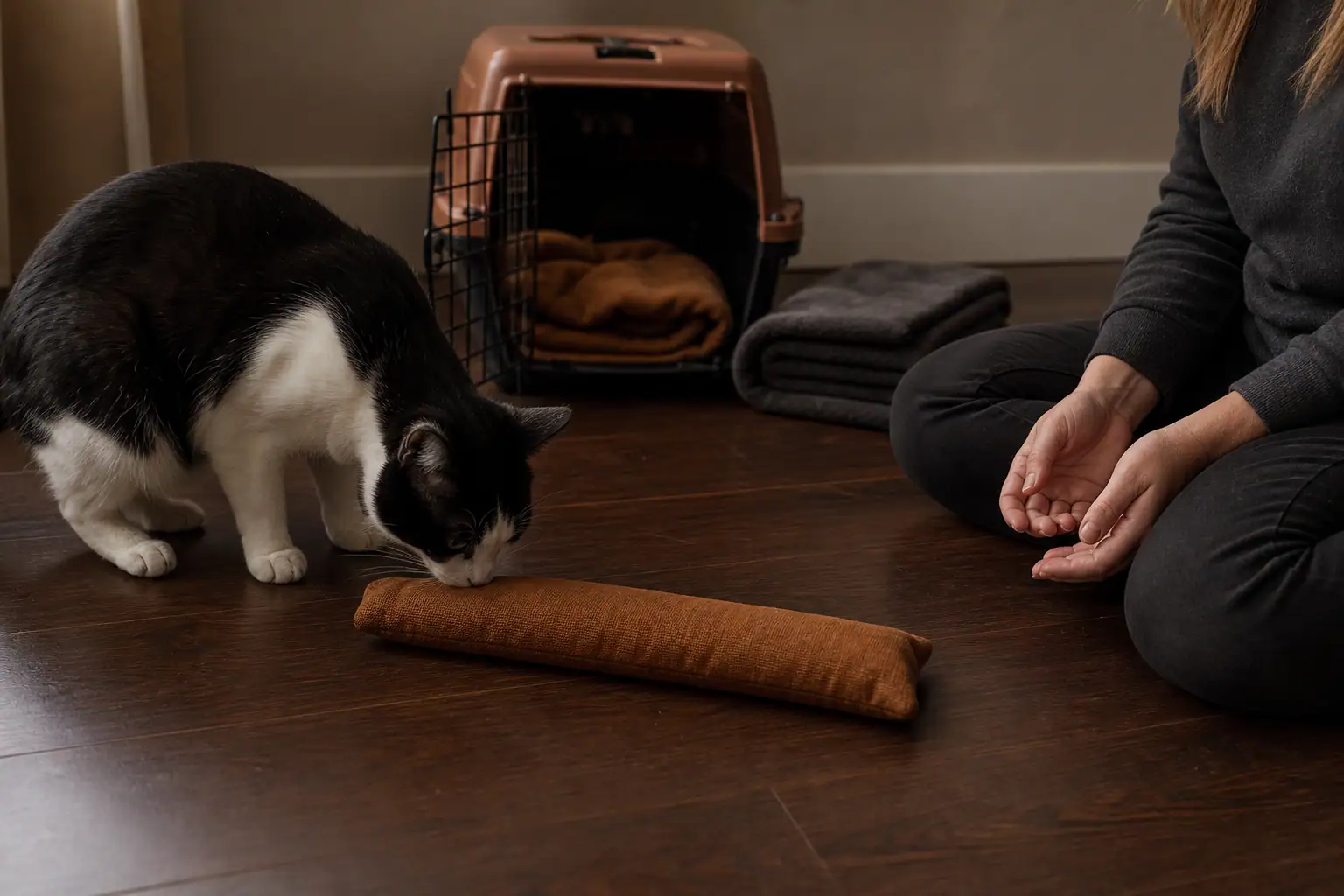
- Make the toy ordinary. Remove packaging elsewhere. Put the switched-off, motionless toy several feet from food, water, litter, and the safe-place entrance. Do not place it inside the hiding spot.
- Let the cat discover it. Sit sideways or continue a quiet routine. Do not carry the cat over, tap the toy against the cat, or block the exit.
- Reward voluntary interest. If the cat looks, sniffs, or approaches with a loose body, calmly place a familiar reward away from the toy so taking it does not require moving closer.
- Add one small action. On a later approach, make a single slow movement away from the cat, then stop. For electronic toys, test the lowest sound and motion setting from a generous distance while you are present.
- Finish early. Allow a catch if the cat pursues, then end while the body remains loose. Store supervised toys out of reach and leave the room predictable.
If the cat freezes, flattens the ears, crouches tightly, lashes the tail, retreats, hides, growls, hisses, or refuses a normally valued reward, stop moving the toy and create distance. Do not keep activating it so the cat will “get used to it.” Forced exposure can make the object a better predictor of threat, not a source of confidence.
Try this calm eight-minute play routine
Predictability can make interactive play easier to understand. Eight minutes is a starting framework, not a quota. A very cautious cat may complete only the first two steps; an energetic rough player may need several short sessions at different times.
- Minute 1—set the scene. Use the same quiet location and a simple start cue. Check the toy, clear the route, and make sure a safe place remains accessible.
- Minute 2—invite. Show the lure at a comfortable distance. Move it once away from the cat, then pause. Never chase the cat with the toy.
- Minutes 3–4—stalk. Use short straight movements, still pauses, and partial cover beside a box or furniture edge. Keep the lure at floor level for a cat who is uncertain or physically limited.
- Minute 5—catch. Let the cat pin and control the lure. Do not pull against teeth or claws, and do not grab the cat or retrieve the toy by hand during a hard grip.
- Minute 6—choose. Offer a stationary kicker or easy food search nearby. The cat may switch, continue watching, groom briefly, or walk away.
- Minute 7—wind down. Make movements smaller and less frequent. Provide one final easy catch rather than ending on frantic pursuit.
- Minute 8—close and inspect. Use a consistent finish cue, store wand parts, check the toy, and note how quickly the cat settles.
Repeatable does not mean rigid. Adjust for age, mobility, respiratory or heart disease, recovery from surgery, and veterinary advice. Our guide to how often to play with your cat can help you divide activity into manageable sessions.
Make the room feel safer than the toy is exciting
An anxious cat rarely needs maximum stimulation. The larger goal is an environment where the cat can predict access to safe places, food, water, litter boxes, scratching, rest, play, and preferred social contact. A toy works inside that system.
- Protect safe places. Do not wave toys into a hide, reach in after the cat, or let another pet guard the entrance.
- Separate key resources. Avoid placing the only play station beside a litter box, noisy appliance, busy doorway, or another cat’s preferred resting area.
- Offer height and cover. A stable perch, open carrier, cardboard box, or furniture route can let the cat observe before joining.
- Keep timing predictable. A short session before a meal or at a naturally active time is easier to anticipate than random high-intensity play.
- Respect scent. Avoid strong fragrance on toys and around resting areas. Familiar bedding and clean, unscented toy materials are a better baseline.
- Rotate lightly. Keep two or three accepted options available and change one at a time. Constant novelty can make preference impossible to read.
For a whole-home plan that also covers scratching, climbing, foraging, rest, scent, and choice, use the Titan Claws cat enrichment guide.
In a multi-cat home, play separately first
A shared toy can become a competition point. One cat may stop approaching because another blocks the route, stares, chases, or takes every catch. Give each cat individual play in a separate location, and duplicate popular resources instead of making them share one station. If there is chasing, guarding, spraying, fighting, or persistent avoidance between cats, discuss inter-cat tension with your veterinarian or a qualified feline behavior professional.
For departure-related distress, do not rely on an automatic toy
Play before a normal departure may be one useful part of a routine, but a motorized toy is not a treatment for separation-related behavior. Note what happens before, during, and after absences; use a camera if it does not disturb the cat; maintain essential resources; and ask your veterinarian about persistent vocalization, elimination, destructive behavior, appetite change, or self-injury. Never leave a new electronic or destructible toy running unattended as a first trial.
Safety rules for anxious cats who play rough
Durability and emotional comfort are separate questions. A familiar plush may be emotionally valuable but unsafe once its seam opens. A rugged new kicker may be physically suitable but initially avoided. Keep both judgments in the routine.
The before-and-after toy check
- Seams and fabric: retire the toy if stitches open, fabric thins through, or filling can be reached.
- Attachments: remove access when feathers, bells, eyes, tails, tabs, knots, or glued trim loosen.
- Hard parts: look for cracks, sharp edges, exposed wire, loose caps, accessible batteries, and gaps that can trap a claw.
- Size: use toys too large to swallow; be especially cautious with foam balls, elastic loops, and small plastic pieces.
- Moisture and odor: clean washable toys according to their material and dry them fully. Retire items that stay saliva-soaked, smell abnormal, or cannot be cleaned safely.
- Play style: supervise any cat who skins fabric, pulls fibers, chews through cord, opens seams, or attempts to eat non-food material.
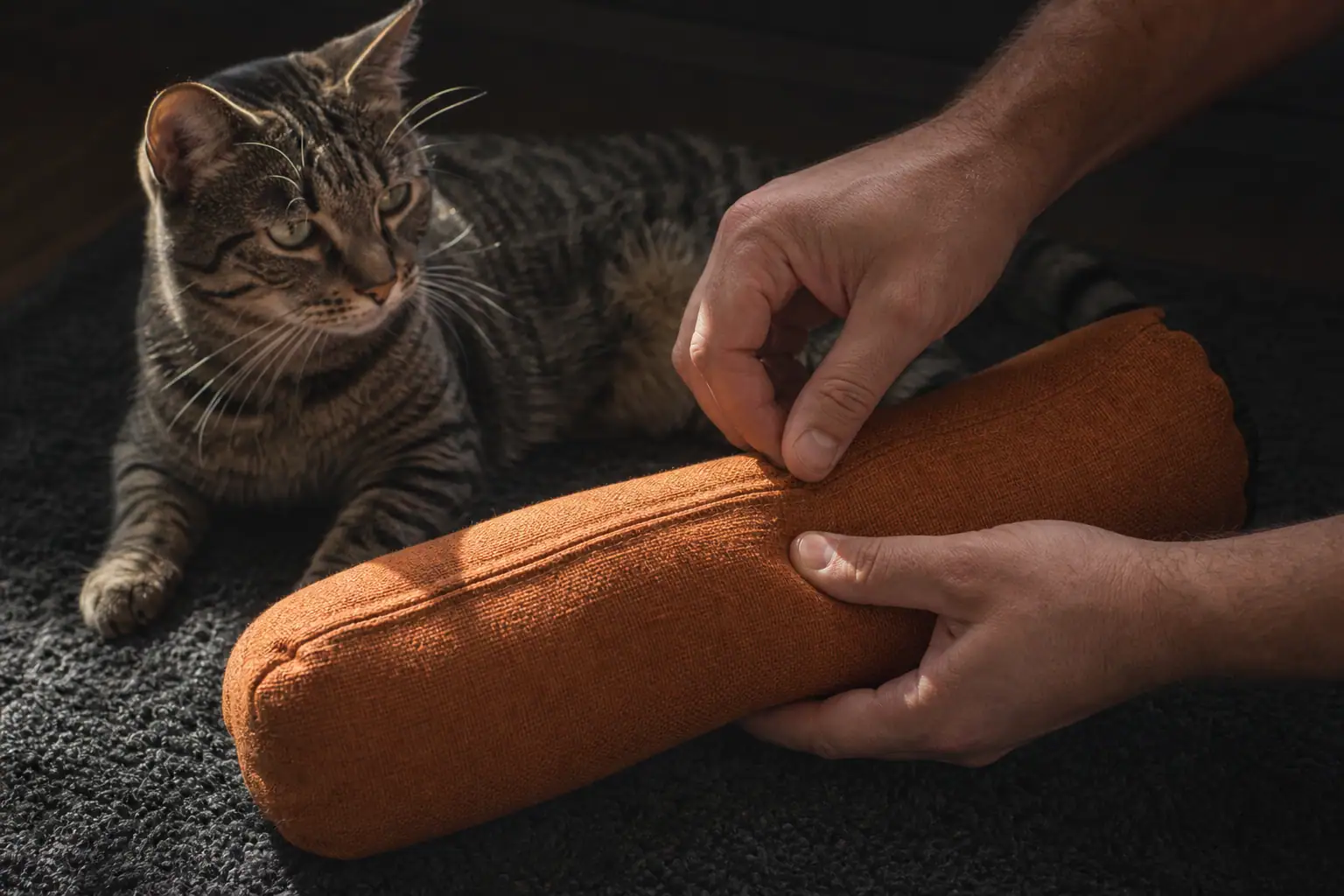
Store wands, ribbons, elastic, cord, feathers, and damaged toys in a closed location after use. If string is hanging from a cat’s mouth or anus, do not pull it; seek urgent veterinary care. Suspected swallowing of any toy piece also warrants prompt veterinary advice.
When toys are not enough
Arrange a veterinary examination for new, persistent, worsening, or intense behavior change. Anxiety-like signs can accompany pain, urinary disease, gastrointestinal illness, skin disease, sensory change, cognitive problems, conflict with another animal, and other conditions. A veterinarian can assess medical contributors and help decide whether environmental changes, a structured behavior plan, referral, or medication is appropriate.
Contact a veterinarian promptly if your cat:
- stops eating, eats markedly less, loses weight, or has repeated vomiting or diarrhea;
- strains to urinate, passes little or no urine, cries in the litter box, or suddenly toilets elsewhere;
- overgrooms to bald skin or sores, injures themselves, or ingests non-food material;
- shows new pain, weakness, limping, reduced jumping, sensitivity to touch, or unusual posture;
- hides persistently, cannot settle after a trigger, or stops normal social and play behavior;
- has escalating aggression or conflict that puts people or animals at risk;
- breathes with the mouth open, struggles to breathe, collapses, has a seizure, or may have swallowed string or a toy piece.
Breathing difficulty, collapse, inability to pass urine, seizures, severe injury, and suspected string or foreign-body ingestion can be emergencies. Contact an emergency veterinary service rather than waiting to see whether a toy or rest changes the behavior.
Quick choice-first checklist
- The cat has a clear retreat route and the toy does not block a safe place.
- The first introduction happens with the toy still, quiet, and several feet away.
- The cat chooses whether to approach; nobody carries or corners the cat.
- Movement travels away from the cat and includes frequent pauses and catches.
- Food puzzles begin easy and use measured, diet-appropriate food.
- Sound, motion, scent, and difficulty change one at a time.
- Each cat in a multi-cat home gets separate play and access to separate resources.
- Wands, cord, feathers, elastic, and electronic toys are supervised and stored.
- Rough-play toys are large, simple, intact, and checked before and after use.
- New or persistent changes in eating, toileting, grooming, movement, sleep, or behavior go to the veterinarian.
What toy is best for an anxious cat?
A quiet fabric wand is the most adaptable starting point because you control its distance, speed, direction, and pauses, and the cat can make a real catch. A shallow food puzzle, large kicker, or stable ball track may suit a cat who prefers stationary or self-directed play. The best individual toy is the one your cat voluntarily approaches and can safely control.
Can toys cure anxiety in cats?
No. Appropriate play and foraging can support environmental needs and a predictable routine, but toys do not cure anxiety or rule out a medical problem. Persistent or significant changes in behavior need veterinary assessment and may require a broader environmental or behavior plan.
Should I leave toys out when my anxious cat is alone?
Leave out only toys already tested under supervision that have no string, elastic, feathers, exposed batteries, small removable parts, sharp edges, or history of being dismantled. Stable puzzles, captive ball tracks, large simple kickers, and sturdy search boxes may be candidates for some cats. Recheck every leave-out toy regularly.
Why is my cat scared of a new toy?
The material, odor, size, sound, movement, location, or the way it was presented may be unfamiliar or intense. Turn it off, create distance, keep it outside safe spaces, and let the cat investigate without pressure. If fear appears across many ordinary situations or recovery is slow, ask your veterinarian for help.
Editorial note: This article provides general enrichment and toy-safety information. It does not diagnose or treat feline anxiety, pain, or illness and does not replace advice from a veterinarian who has examined your cat.
Leave a Reply