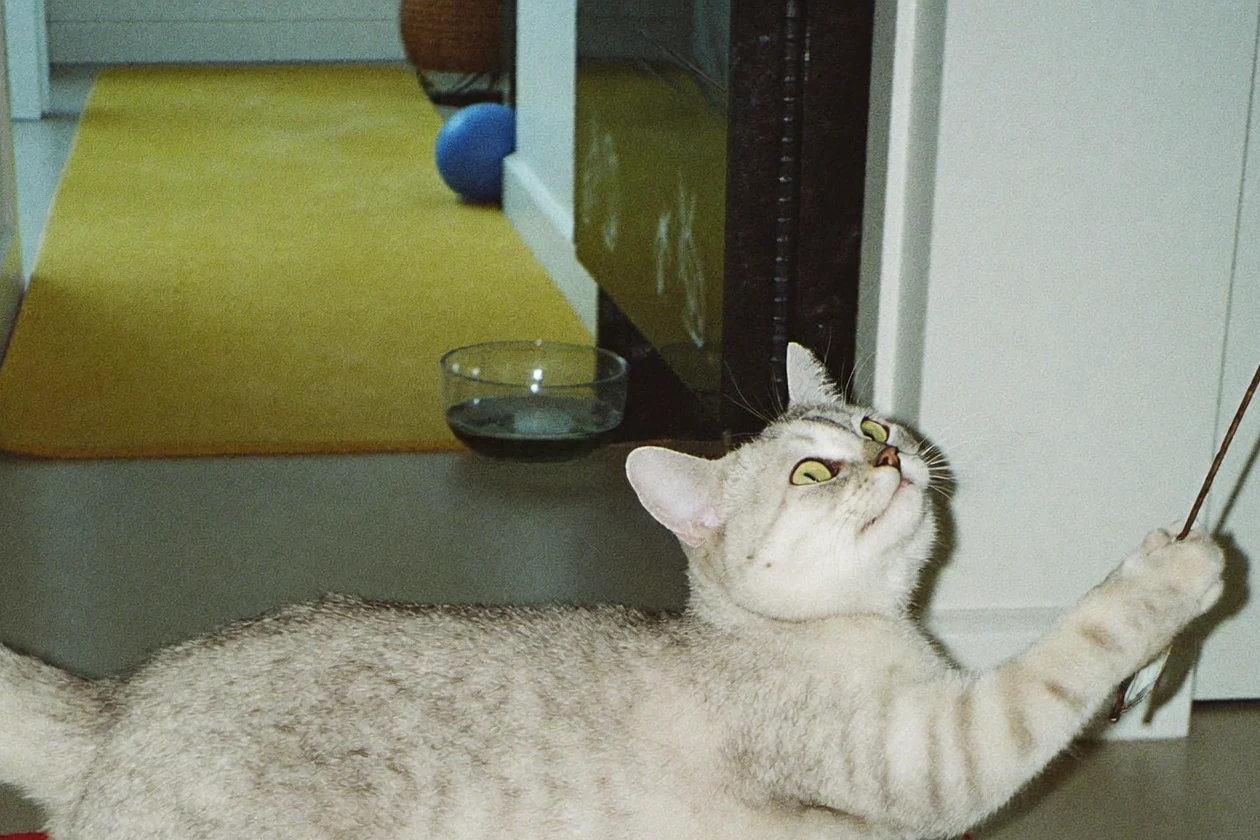
Interactive play for cats is play you actively control so a toy behaves like something the cat can stalk, chase, pounce on, catch, and hold. A wand lure is the easiest tool, but a tossed mouse, rolling ball, tunnel game, or food hunt can work too. The crucial part is not the word interactive on the package. It is the back-and-forth between you, the toy, and your cat.
Start with one or two short sessions a day and let your cat’s response set the pace. Move the target away rather than pushing it into the cat’s face, build in pauses, allow frequent catches, and finish with a capture your cat can bite or kick. For a rough player, use distance, sturdy capture toys, supervision, and a before-and-after damage check.
What counts as interactive play?
People use interactive cat toy to describe almost anything that moves, lights up, dispenses food, or reacts to a paw. Those products can provide enrichment, but person-led interactive play is more specific: you watch the cat and change the game in real time. You can slow down when the cat crouches, freeze the lure when they prepare to pounce, or switch from a flying movement to a floor-level scurry.
| Play type | Who controls it? | Best use | Main limit |
|---|---|---|---|
| Person-led interactive play | You and the cat | Chase, pounce, capture, exercise, shared routine | Needs your attention and supervision |
| Solo play | The cat | Batting, carrying, wrestling, short independent bursts | Some toys are not safe to leave out |
| Puzzle or food hunt | The cat, with your setup | Foraging and problem-solving | Must be introduced at an achievable level |
| Automatic toy | A motor or program | Novel movement and occasional supplemental activity | Cannot read fatigue, fear, damage, or frustration like a person can |
Play is not just a bonus for indoor cats. The Feline Veterinary Medical Association includes opportunities for play and predatory behavior, along with positive and predictable human interaction, among the pillars of a healthy indoor environment. A 2023 survey of 1,591 cat guardians also found that more games played was associated with higher owner-rated feline quality of life, while more daily play and more games were associated with stronger cat–guardian relationship scores. Those are associations rather than proof of a guaranteed effect, but they support making varied play a regular part of care.
First identify your cat’s preferred prey game
The most stimulating toy is the one that produces the behavior your cat already wants to perform. Before buying another gadget, test several movement patterns with a safe wand lure and notice which one changes your cat from watching to participating.
- Ground hunter: drag the lure along the edge of a wall, rug, or box. Use short scurries and long freezes, as if a mouse is trying not to be seen.
- Air hunter: make a fabric lure hop onto a low cushion or briefly flutter, then land. Avoid nonstop circles above the cat’s head; prey that never comes within reach is just a ceiling fan with extra steps.
- Ambusher: slip the lure behind a tunnel, paper bag with handles removed, or furniture corner. Reappear for a moment, then pause close enough for a pounce.
- Chaser: roll a large ball or toss a soft mouse across—not toward—the cat. Keep the route clear and use a toy too large to swallow.
- Wrestler: finish the chase with a long kicker or dense capture toy the cat can grip, bite, and rake without reaching your hands.
- Forager: hide a few pieces of the cat’s measured meal in an easy puzzle or around one room. Increase difficulty only after the cat succeeds.
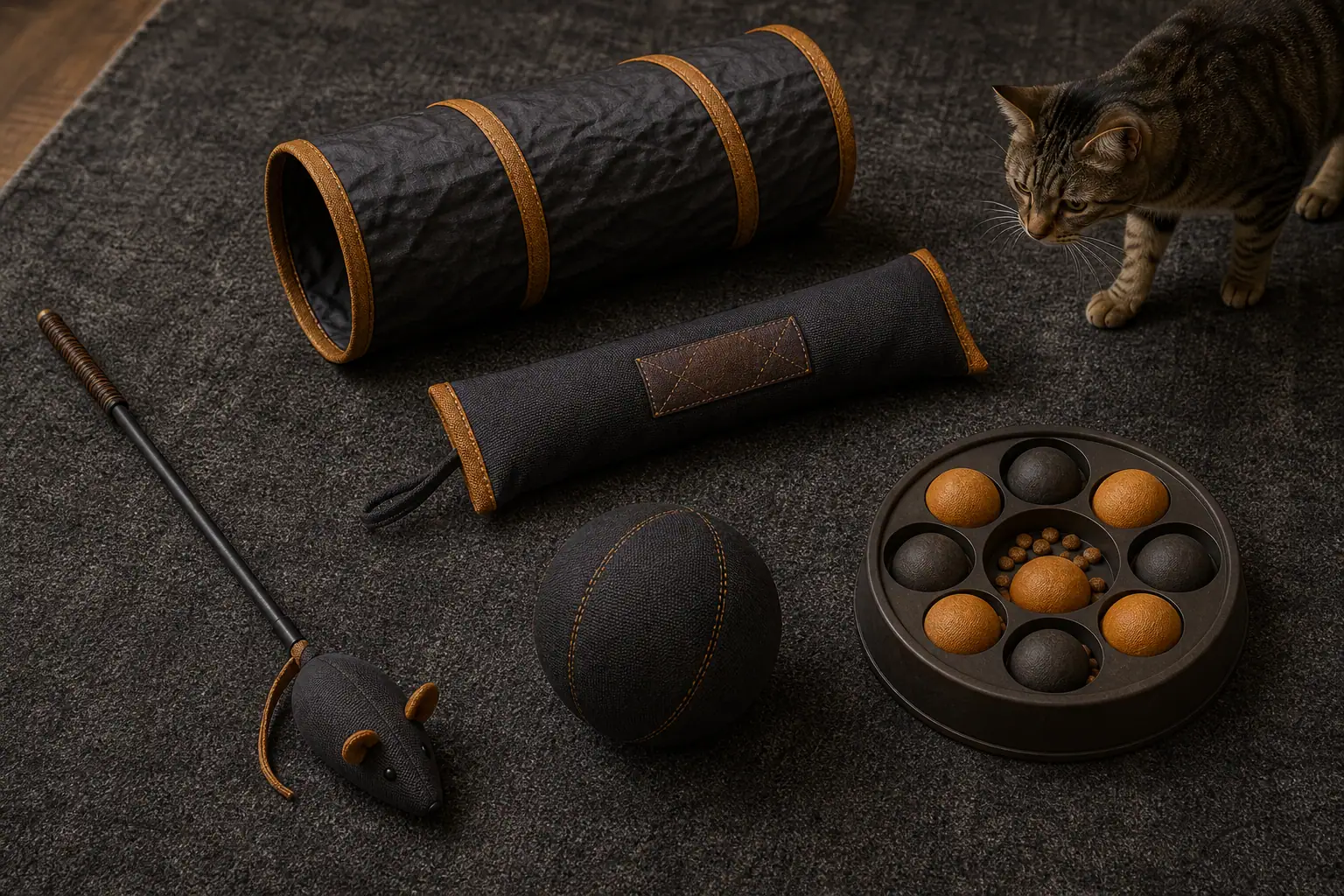
Some cats mix styles; others care deeply about one. Texture, sound, scent, time of day, and where the toy disappears can matter more than price. If your cat ignores one motion pattern, change only one variable at a time. That makes it easier to learn whether the problem was speed, location, toy texture, noise, or timing.
Use this hunt-catch-cool-down routine
This 10-minute framework is a starting point, not a quota. A kitten may want several short rounds; a senior or cautious cat may be satisfied after two minutes. Stop while the cat is still comfortable, and see our daily cat play schedule for age, health, and energy adjustments.
- Set the stage (one minute). Clear cords, breakables, other pets, and slippery obstacles. Choose a lure and a safe capture toy. Invite the cat; do not carry a resting or hiding cat into the game.
- Wake up the hunt (one to two minutes). Start the toy partly hidden and nearly still. A twitch behind a box is usually more convincing than tapping the cat with the lure.
- Stalk and chase (two to three minutes). Move away in uneven bursts. Travel around obstacles, freeze, then flee again. Keep jumps low and traction good.
- Allow catches (throughout). After a short chase or pounce, let the cat pin the toy. Keep tension off the cord. If the cat releases it, wait before bringing the prey back to life.
- Give a final capture (one to two minutes). Let the cat hold the lure or transition to a larger kicker. Do not yank a captured toy from the mouth or paws.
- Cool down (one minute). Make the last movement smaller, end on a catch, then put away stringed equipment. If it fits the cat’s diet, you can offer a small portion of the normal meal or a food-puzzle finish.
A good session has changes in intensity. Staring, creeping, waiting, and repositioning all count as play; the cat does not need to sprint continuously. Cats Protection notes that even one- or two-minute games can be worthwhile and recommends regular short sessions, toy rotation, catches, and wear checks.
If your cat watches but will not chase
Watching is not failure. A cat may spend much of a hunt assessing distance and timing. Look for ears and eyes tracking the toy, weight shifting forward, a low crouch, whiskers oriented ahead, or the hindquarters preparing to spring. If you see those signs, slow down and wait.
If interest never builds, work through this order:
- Change the time. Try just before a usual meal or during the cat’s naturally active morning or evening period, not during a deep nap.
- Change direction. Prey usually escapes. Move the toy across the cat’s field of view and away, never repeatedly at the face.
- Add cover. Let the toy vanish behind a box, tunnel, chair leg, or blanket edge. Partial concealment often creates more interest than speed.
- Change the prey profile. Test floor movement, a brief hop, a roll, rustle, or scent. Use a different lure texture before buying a whole new system.
- Lower the pressure. Sit sideways, avoid looming, and leave space for the cat to withdraw. In a multi-cat home, try a separate room so one cat cannot block another.
- Make success easier. Shorten the distance and freeze after a paw touch. Do not make the cat miss again and again.
If you are unsure whether the cat is inviting play or asking for space, use the body-language checks in our guide to signs your cat wants to play. Never punish, chase, or tease a cat for declining.
Choose toys that survive the session—not toys you can forget
No cat toy is indestructible. A durable toy should buy you more safe play and make wear easier to spot; it does not remove the need to supervise or replace it. For cats that bite hard or bunny-kick, pair the movement tool with a separate, larger capture target.
- Wand: use a handle long enough to keep teeth and claws away from skin, a secure connection, and a lure sized for the cat’s mouth and play style. Store the full wand and cord in a closed place after use. Our cat stick toy guide covers the hardware in detail.
- Kicker: look for dense fabric, reinforced seams, no glued decorations, and enough length for the cat to grip with the forelegs while kicking with the hind legs.
- Ball or toss toy: choose a size the cat cannot swallow or compress into the back of the mouth. Avoid cracked plastic, exposed bells, and pieces that detach under chewing.
- Tunnel or box: check stability, remove bag handles and staples, and provide an unobstructed exit. Do not collapse the tunnel around the cat.
- Puzzle feeder: begin open and easy. Count food toward the daily ration, wash food-contact surfaces, and remove the puzzle if the cat chews off pieces. Use our puzzle cat toy introduction steps to prevent frustration.
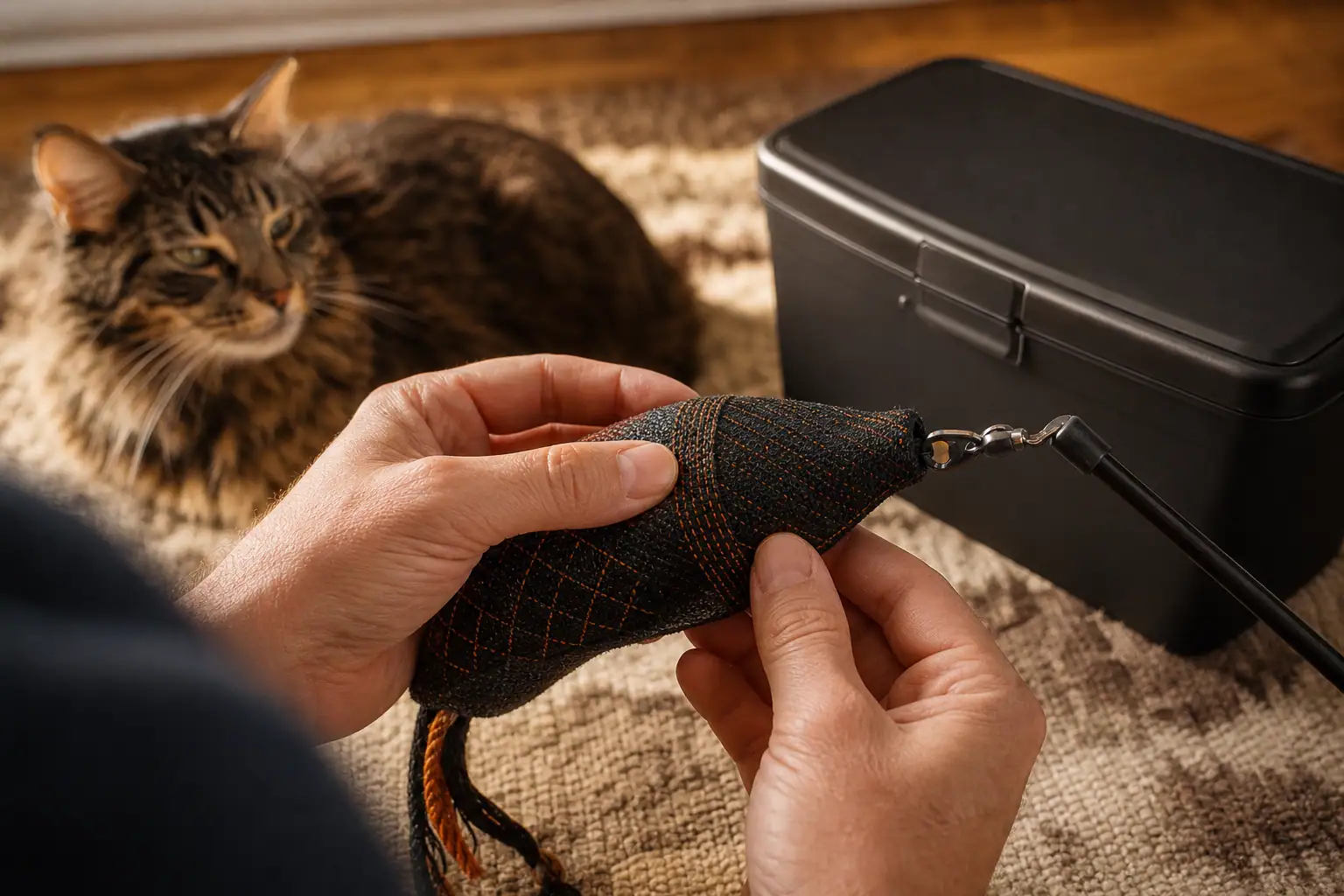
Inspect before and after rough sessions. Check seams, fabric thinning, punctures, stuffing migration, knots, elastic, swivel clips, glue points, feathers, bells, battery doors, and sharp edges. Retire the toy when its shape changes, a seam gaps, a hard part becomes exposed, or pieces begin to loosen. Do not wait for total failure.
Can automatic toys replace interactive play?
Automatic toys can add variety, especially when you need to prepare dinner or join a meeting, but they are a supplement rather than a complete substitute. A motor cannot notice that one cat is afraid, another is blocking access, the lure has torn, or the cat has become tired. Many electronic toys also introduce charging cables, battery compartments, wheels, hard shells, and unpredictable starts.
Use a new automatic toy under direct supervision first. Confirm that it cannot trap paws or whiskers, tip, overheat, expose a battery, wedge under furniture, or shed a chewable attachment. Choose a timer and a clear floor zone, and remove it if play becomes frantic or repetitive. For shopping and setup details, see our automatic cat toy safety guide.
Laser play also needs special handling because the cat cannot physically capture the dot. If you use one, keep it away from eyes and reflective surfaces, make the chase brief, and transition to a real toy the cat can catch. Read the full laser toy risk and finish routine before using it as a regular game.
A realistic seven-day interactive play reset
You do not need seven new toys. Use one reliable wand or toss toy, one capture toy, a box or tunnel, and part of the cat’s normal food for variety.
| Day | Small change | What to observe |
|---|---|---|
| 1 | Test a floor-level scurry | Does the cat track, stalk, chase, or wrestle? |
| 2 | Add a box corner or tunnel | Does concealment create more interest? |
| 3 | Play at a different active time | Is engagement stronger before a meal or near dusk? |
| 4 | Switch lure texture or sound | Does fabric, rustle, or silence change the response? |
| 5 | Finish with a kicker | Does a larger catch reduce grabbing at hands or the cord? |
| 6 | Use an easy food hunt | Does the cat prefer searching and paw work to chase? |
| 7 | Repeat the best combination | Can you turn the favorite into a predictable routine? |
Write down only three things: time, game, and response. At the end of the week, keep the two combinations that consistently invite relaxed participation. Rotate the other toys out of sight for later instead of leaving every option on the floor until it becomes background clutter.
When to stop play or call a veterinarian
Stop the session if your cat repeatedly turns away, leaves, hides, flattens the ears, lashes the tail, growls, pants, limps, or redirects hard bites toward people or another cat. Give space and lower the intensity next time. Do not grab an aroused cat or use hands as the target. If rough attacks are a pattern, follow this plan for cat play aggression toward an owner.
A sudden drop in play can be a health signal rather than boredom. Contact your veterinarian if a normally playful cat stops engaging, especially with appetite change, hiding, stiffness, lameness, weight change, breathing changes, vomiting, disorientation, or unusual vocalization. Older cats can still enjoy play, but pain, dental disease, arthritis, vision or hearing changes, and other conditions may require a gentler setup or treatment.
If you think your cat swallowed string, elastic, part of a lure, stuffing, a bell, or another toy component, contact a veterinarian or emergency clinic rather than waiting for symptoms. Vomiting, refusal to eat, lethargy, abdominal pain, and difficulty getting comfortable can accompany a gastrointestinal foreign body.
Quick interactive play checklist
- Invite the cat; never force participation.
- Move the target away, with cover, pauses, and changes of speed.
- Match the game to chase, ambush, wrestle, forage, or another observed preference.
- Let the cat catch the toy often and finish with a satisfying capture.
- Keep hands and feet out of the prey role.
- Use short sessions and adjust from body language, age, mobility, and health.
- Supervise wands, strings, ribbons, feathers, electronic toys, and anything that can be shredded.
- Inspect before and after play; replace at the first unsafe change.
- Store stringed equipment in a closed place.
- Ask a veterinarian about sudden behavior or activity changes.
Great interactive play is less about exhausting a cat and more about making the game readable and winnable. When the toy behaves like catchable prey—and the routine respects the cat’s choices—you learn what genuinely engages your cat instead of hoping the latest gadget will do it for you.
Sources
- Feline Veterinary Medical Association: Meeting the needs of indoor cats — the five-pillar framework, including play, predatory behavior, and predictable human interaction.
- Henning et al., Animal Welfare (2023): Cats just want to have fun — a survey study on associations among play, owner-rated quality of life, and cat–guardian relationships.
- Delgado et al., Applied Animal Behaviour Science (2024): Barriers to daily cat playtime — research on interactive wand play habits and practical owner barriers.
- Cats Protection: Cats and play — short sessions, prey-style movement, catches, rotation, supervision, and inspection guidance.
- VCA Animal Hospitals: Linear foreign bodies in cats — why swallowed string and similar materials require urgent veterinary guidance.
Leave a Reply