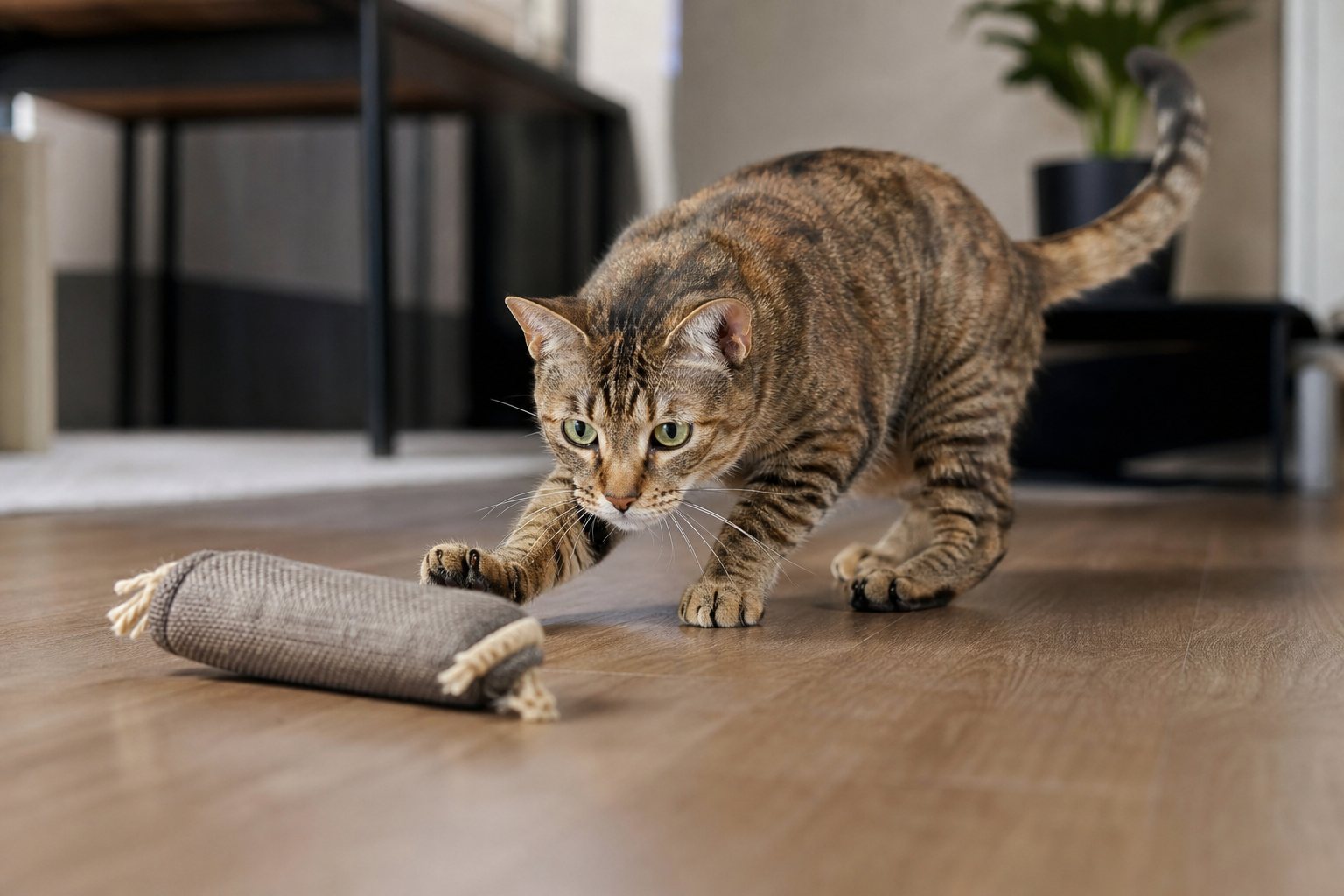
Cat aggressive play is rough play that uses normal hunting behaviors in the wrong place, at the wrong intensity, or toward the wrong target. It can look like ankle ambushes, hard biting, bunny-kicking arms, stalking another cat that wants to leave, or sudden pounces from behind furniture. The cat is not necessarily being spiteful, but the behavior still needs a plan because teeth and claws can injure people, stress other pets, and teach the cat that bodies are acceptable prey.
The safest approach is to read the body language early, stop using hands or feet as toys, schedule play before the usual attack window, redirect the cat onto appropriate toys before contact happens, and get veterinary or behavior help if the aggression is sudden, severe, painful, escalating, or directed at vulnerable people or pets.
What Cat Aggressive Play Looks Like
Play aggression often borrows the same sequence cats use for hunting: watch, stalk, chase, pounce, grab, bite, and kick. In a healthy play session, those actions are directed at toys and the cat can recover quickly. In aggressive play, the target may be your ankle, your hand, a child running through the room, or another pet that is no longer enjoying the interaction.

Common signs include:
- crouching behind furniture, then launching at passing feet;
- wide pupils, tail swishing, focused staring, and a wiggling rear end before the pounce;
- grabbing hands or sleeves during play;
- biting harder as the session gets faster;
- bunny-kicking arms, legs, or another cat’s body;
- repeatedly chasing a cat that is trying to retreat;
- morning or evening bursts that line up with natural high-energy periods.
The San Francisco SPCA notes that play aggression can happen in cats of any age and can become intense when people become the target. Cornell Feline Health Center describes classic pre-pounce signals such as tail thrashing, pinned ears, dilated pupils, stalking, and pouncing from hiding places. Those cues are useful because they give you a chance to redirect before contact.
Is It Play or Real Aggression?
Normal rough play and unsafe aggression can overlap, so focus on risk and recovery rather than trying to guess the cat’s intention. Play usually has loose movement, pauses, role changes, and quick recovery. More concerning aggression often includes sustained pursuit, growling, hissing, defensive crouching, blocked escape routes, puncture bites, repeated targeting of one individual, or a cat that stays aroused long after the incident.
ASPCA separates aggressive body language into offensive and defensive patterns, and it cautions people not to touch, reassure, or punish cats that are showing those postures. Cornell also emphasizes that aggression can have different causes, including play, fear, pain, territorial conflict, petting intolerance, and redirected arousal. That matters because the right response for play aggression may be wrong for fear or pain.
Use this practical distinction: if the cat is playful but misdirected, redirect with distance toys and a routine. If the cat is scared, painful, cornered, or unable to calm down, create space and get help instead of trying to play through it.
Why Cats Get Too Rough During Play
Several patterns show up again and again:
- Too little structured play: VCA Animal Hospitals links under-stimulation, unused energy, and lack of appropriate play opportunities with play-related aggression.
- Hands became toys: wrestling with kittens teaches the cat that skin is a legal target when adult teeth and claws arrive.
- No complete catch: chasing a laser or feather forever without a real capture can leave some cats more frustrated.
- Young or high-drive cats: kittens, adolescents, and energetic indoor cats often need more frequent outlets.
- Solo early history: Cornell notes that young cats raised without littermates may miss some bite-inhibition lessons learned during kitten play.
- Overstimulation: play can tip from fun into frantic when the session gets too long, too fast, or too repetitive.
- Another trigger nearby: a cat watching an outdoor cat, hearing a loud noise, or arguing with another pet may redirect that arousal onto whoever approaches.
The fix is rarely one magic toy. It is usually a better pattern: predictable play, better distance, legal bite-and-kick targets, calmer finishes, and clear rules from every person in the home.
Redirect Before the Pounce
Timing matters. If you toss a toy after your cat has already bitten your ankle, the cat may learn that biting starts an exciting game. If you redirect when you see the pre-pounce signs, the cat learns that toys are the outlet.
Keep a few appropriate redirect toys in the rooms where rough play starts. When you see crouching, corner stalking, wide pupils, or tail swishes, move a wand lure along the floor away from your body or toss a larger toy away from your feet. Make the toy act like prey: away, around a corner, under the edge of a box, pause, move again. Do not wave it into the cat’s face.
If contact already happened, become boring. Freeze if you can, calmly remove attention, step behind a barrier if needed, and wait for the arousal to drop. Restart a structured play session after a reset, not at the exact second teeth hit skin.
A Safer Play Routine for Rough Cats
Use this once or twice daily, especially before the time your cat usually gets rough. For many cats that means morning and evening.

- Warm up for two minutes. Let the cat watch and stalk. Move the toy slowly along the floor, behind a chair leg, or around a box.
- Chase for five minutes. Move the lure away from the cat in short bursts. Pause so the cat can plan.
- Catch for three minutes. Let the cat land on a longer kicker toy, bite it, and bunny-kick that instead of you.
- Repeat at lower intensity. Give one more easier chase and catch so the session winds down instead of spikes.
- Cool down. Offer a small food puzzle, a few pieces of kibble to forage for, or quiet distance. Avoid immediate petting if the cat is still in hunt mode.
For toy-specific help, use Titan Claws guides to cat toys for play aggression, cat kicker toys, and wand cat toys. This article is the behavior plan; those guides help you choose the tools.
What to Do When Cats Play Too Rough With Each Other
Cat-to-cat aggressive play needs a different standard because one cat may enjoy the chase while the other feels trapped. Maddie’s Fund, using San Francisco SPCA guidance, notes that play aggression between cats can involve biting, clawing, stalking, and attacking other cats, and that it can be especially common when a younger cat is introduced to an older cat with a different energy level.

Intervene when one cat is always the pursuer, the other cat hides or avoids rooms, hissing and growling increase, fur flies, litter box habits change, or one cat blocks food, water, doorways, resting places, or escape paths. Add vertical space, separate resting zones, multiple resources, and separate play sessions so the high-energy cat has an outlet that does not depend on the other cat participating.
Do not punish either cat. Interrupt early with distance and management: move a toy away from the victim cat before the chase starts, close a door for a calm reset, and reintroduce with positive associations if the relationship has become tense.
Toys That Help, and Toys to Supervise
For aggressive play, the best toy is the one that creates distance, gives a legal target, and survives inspection after rough contact. A useful setup includes a wand or teaser for chase, a long kicker for the grab-and-kick phase, and safe solo enrichment such as a puzzle feeder, sturdy track toy, tunnel, or box with handles and loose parts removed.
Supervise or avoid toys that become risky under hard biting:
- hands, feet, sleeves, and blankets moved like prey;
- string, yarn, ribbon, elastic, and feather lures left out after play;
- tiny plush toys that fit fully in the mouth;
- glued-on eyes, bells, sequins, thin tails, and removable parts;
- fragile plastic or electronic toys with weak battery doors or exposed cords;
- catnip toys if catnip makes your cat noticeably more intense.
For cats that destroy ordinary toys, start with Titan Claws on durable cat toys, toys for cats that chew, and cat enrichment activities. Avoid treating any toy as indestructible. The safer standard is matched size, fewer weak points, supervision when needed, and early replacement.
The After-Play Safety Check
Aggressive play puts more force into toys than casual batting. After a hard session, inspect before the toy goes back in the basket.
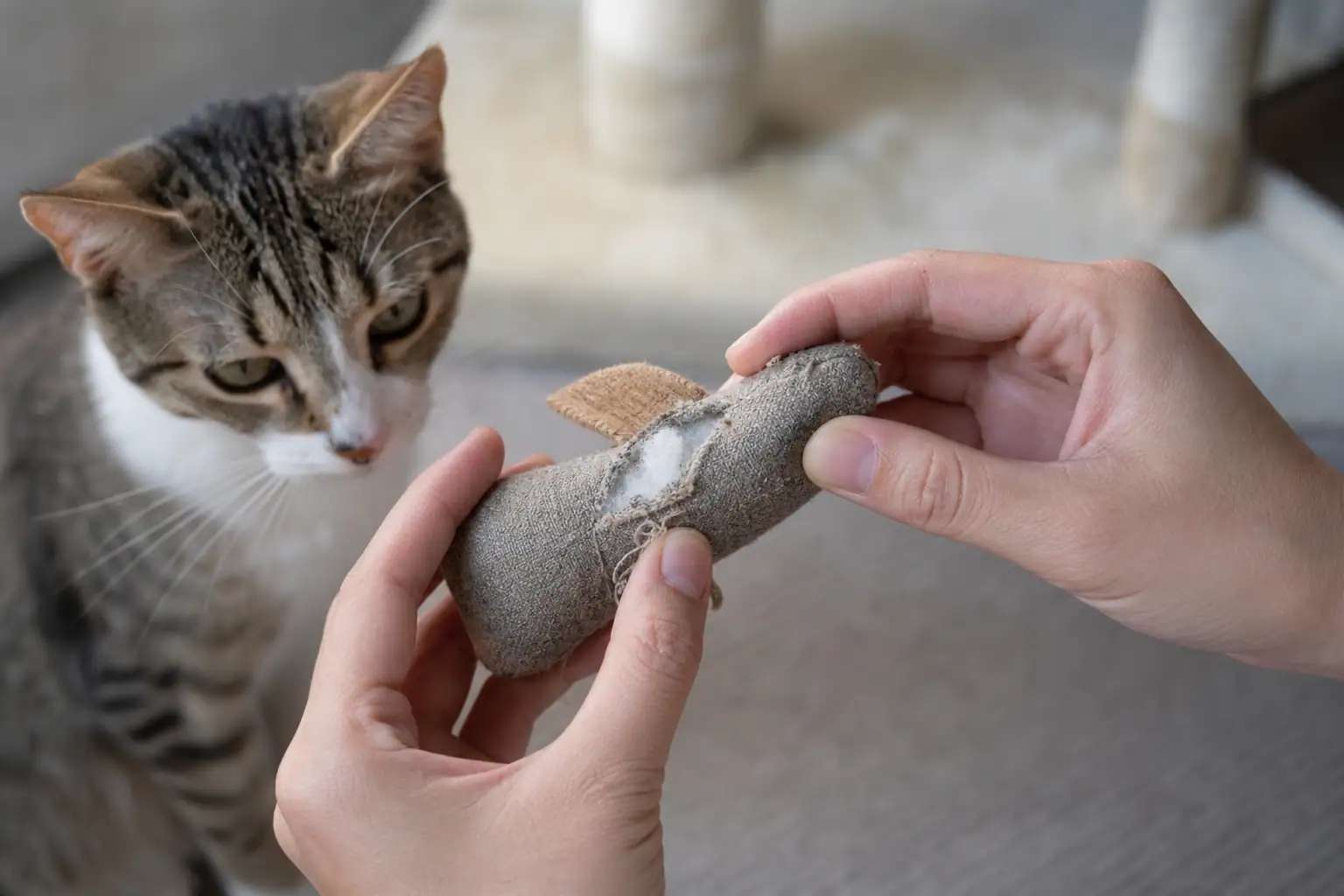
- Are seams opening or threads hanging?
- Is stuffing visible?
- Are feathers, bells, eyes, clips, tags, or plastic pieces loosening?
- Is a cord, ribbon, or elastic section chewed?
- Are there cracks, sharp edges, exposed wire, or battery-door problems?
- Can your cat fit the whole toy in their mouth?
- Did your cat try to eat fabric, fuzz, cardboard, or plastic instead of just playing?
Retire questionable toys early. Cornell Feline Health Center’s safe-toy guidance is especially relevant for rough players because small pieces and strand-like materials can become ingestion hazards. If your cat repeatedly eats non-food material, ask your veterinarian for guidance.
When to Call a Veterinarian or Behavior Professional
Get professional help if aggression is sudden, escalating, breaking skin, targeting children or vulnerable adults, injuring another pet, or happening outside obvious play contexts. Also call your veterinarian if the cat seems painful, hides more, eats less, avoids jumping, reacts to touch, changes litter box habits, or is older and newly irritable. Cornell lists medical issues such as hyperthyroidism, osteoarthritis, dental disease, and central nervous system problems as possible contributors to aggression, so a health check belongs early in the plan.
A qualified feline behavior consultant or veterinary behaviorist can help if the pattern is complex, especially with fear, redirected aggression, multi-cat conflict, or attacks that feel unpredictable. Medication is sometimes part of a veterinary behavior plan, but it works alongside environmental changes and training, not instead of them.
Quick Checklist
- Stop using hands, feet, and sleeves as toys.
- Watch for pre-pounce signs: crouching, tail swishing, wide pupils, hiding, and focused staring.
- Redirect before contact, not as an instant reward after a bite.
- Schedule play before the usual rough-play window.
- Use distance toys for chase and longer kickers for the hard catch.
- Give multi-cat households more space, vertical routes, and separate resources.
- Inspect toys after rough sessions and retire damaged pieces early.
- Do not punish, yell, wrestle, or grab an aroused cat.
- Get veterinary help for sudden, severe, painful, or unsafe aggression.
Cat aggressive play improves when the household stops practicing the wrong game. Read the warning signs early, give the cat a legal target, finish with a real catch, and keep damaged toys out of rotation. You are not trying to erase hunting behavior. You are teaching it where to go.
Leave a Reply