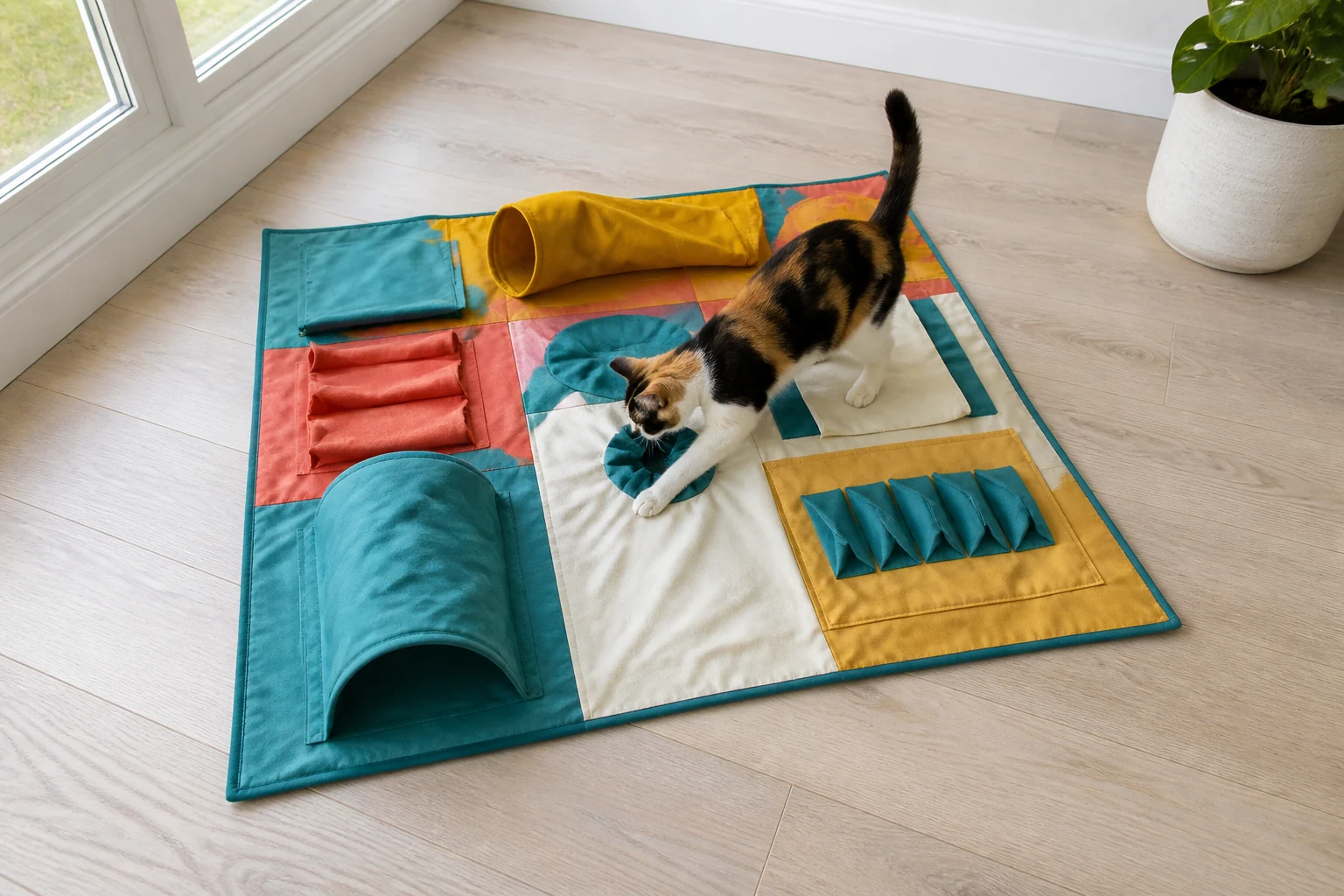
A cat play mat is a floor-level play surface that adds texture, cover, movement, or places to hide a toy. The best one is stable under a pounce, easy to inspect and clean, and simple enough for your cat’s actual play style. It should make stalking, chasing, pouncing, grabbing, or resting more interesting without surrounding your cat with loose strings and breakable add-ons.
For most cats, start with a washable fabric or felt mat with securely finished edges and no exposed filling. Choose a ripple or tunnel-style mat for a cat that likes hiding and ambushing, a padded flat mat for a wrestler or senior cat, and a concealed-motion mat only when you can supervise the moving mechanism. Cats that chew foam, pull seams, or swallow fabric need a stricter material test and closer supervision.
What counts as a cat play mat?
The name covers several different products. Some are essentially soft landing zones. Others fold into caves, hide a motorized lure, dispense food, or imitate a baby activity gym with toys hanging overhead. Those designs create different kinds of play and different failure points.
| Mat type | Best use | Main watchpoint |
|---|---|---|
| Flat padded fabric mat | Wrestling, rolling, scent play, and a softer landing surface | Opened seams, exposed filling, or a slippery underside |
| Ripple, rug, or tunnel mat | Hiding, peeking, stalking, and ambushing a lure | Frayed openings, failing fasteners, or a tunnel that collapses around a worried cat |
| Crinkle mat | Sound and texture for cats that enjoy noisy ground prey | Torn outer fabric that exposes the inner film |
| Concealed-motion mat | Chasing a moving target beneath a cover | Access to the motor, battery compartment, moving arm, or charging cable |
| Mat with hanging toys | Reaching and batting during supervised play | Elastic, cord, clips, bells, feathers, or a frame that tips |
| Lick mat | Food-based licking and a slower treat activity | Chewed silicone, inappropriate food, and leaving it down after the food is gone |
A lick mat is therefore not a direct substitute for an activity mat: one organizes food enrichment; the other organizes object play. A water-filled sensory mat made for a human baby is not automatically a cat toy either. A claw puncture can expose its liquid or internal pieces, and the maker may not have designed the seams or contents for biting. Use products according to their intended species and instructions.
Commercial ripple mats show why structure matters. For example, the maker of the Ripple Rug describes large openings, configurable fasteners, finished edges, a nonslip base, and soap-and-water care. Those are useful features to evaluate in any shaped mat, but they are not a promise that every cat will like it or that no cat can damage it. The product page itself tells owners to supervise, inspect, and remove a damaged mat.
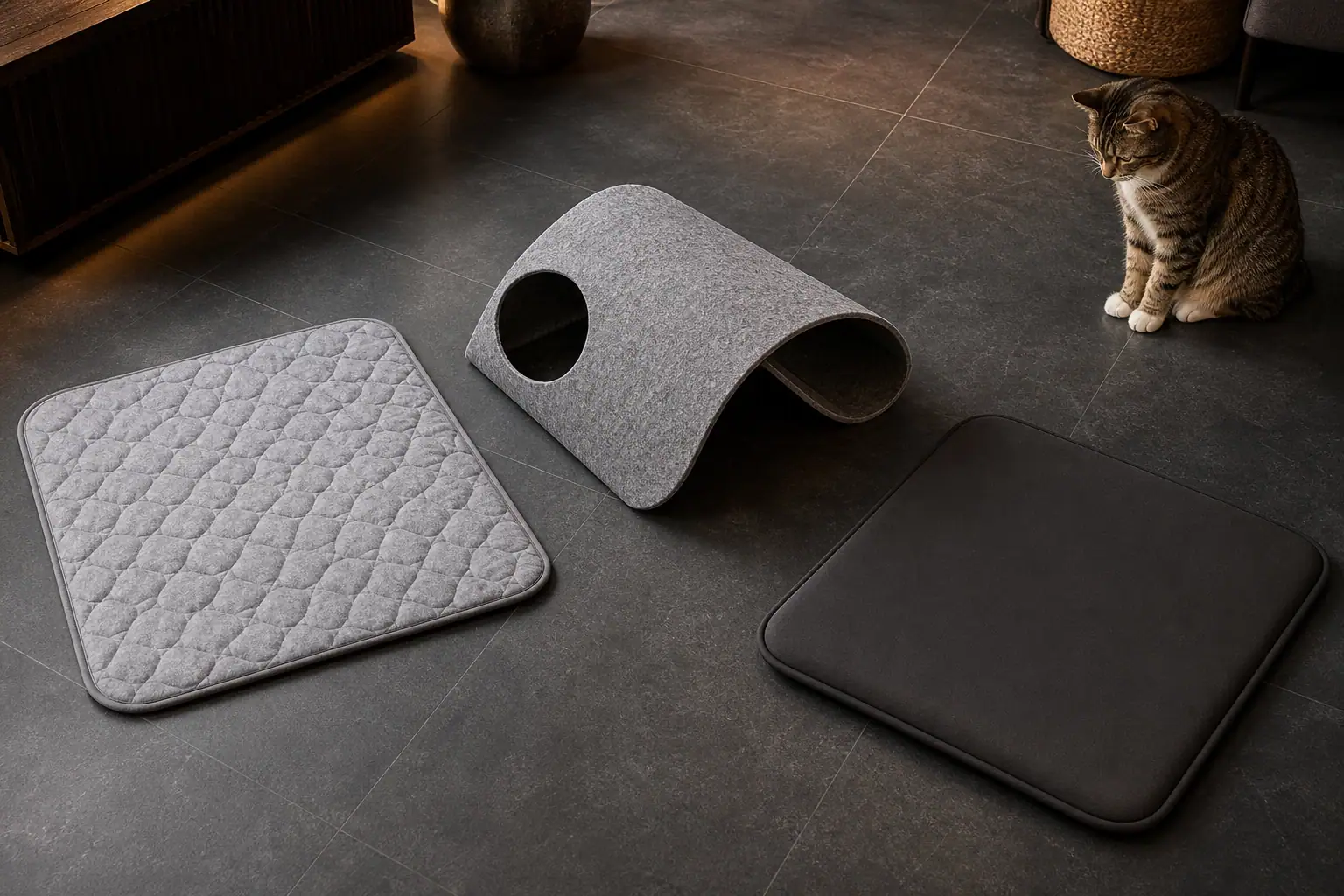
How to choose a cat play mat that fits your cat
Start with behavior, not the product photo. Watch what your cat already does with boxes, rugs, blankets, and toys. The goal is to give that behavior a better surface—not to buy the greatest number of features.
- For a stalker: choose large sight openings, a low tunnel, or a mat you can reshape. The cat should be able to watch a lure disappear and choose when to pounce.
- For a rabbit-kicker: prioritize a broad stable base with tough bound edges. Add a separate appropriately sized kicker rather than expecting the mat’s corner or hanging toy to absorb every bite.
- For a burrower: use a structure with more than one obvious exit. Avoid deep pockets that tighten around the body or trap a collar, leg, or claw.
- For a high-speed chaser: look for a nonslip underside and enough clear floor around the mat for braking. Do not place it beside stairs, glass, hot appliances, or sharp furniture corners.
- For a senior or mobility-limited cat: choose a low-entry mat with firm footing and place the lure within comfortable reach. Watching, pawing, and short pounces still count as play.
- For a rough destroyer: choose the fewest components, visible stitching, no glued decoration, no exposed foam, and no attachments you cannot remove for a safer solo-use setup.
Size matters in two ways. The mat needs enough area for your cat to enter, turn, and exit without feeling cornered, but it should not take over the room’s escape routes. In a multi-cat home, do not force cats to share one small tunnel. Provide separate play stations and keep doorways, litter routes, food, water, and resting areas accessible.
A hands-on store or unboxing test
- Rub the surface. Reject a mat that sheds tufts, flakes, or grit with light friction.
- Flex every edge. Bound edges should stay flat without revealing foam, plastic film, wire, or filling.
- Tug each attachment. Bells, feathers, elastic loops, hook-and-loop tabs, and plastic clips are extra failure points. Remove optional attachments when the mat works without them.
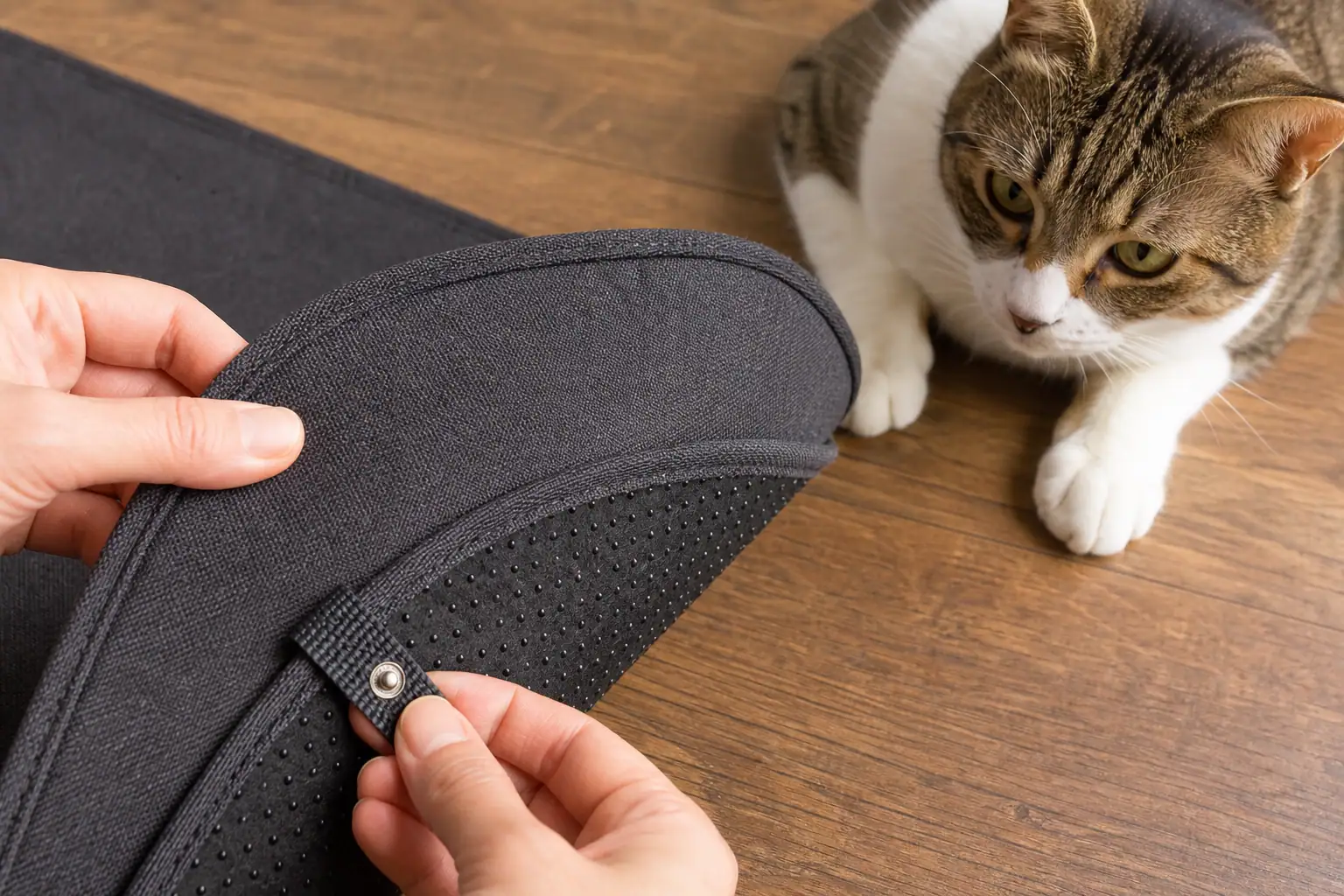
- Press the base sideways. A pounce should not send the mat skating. Nonslip performance varies by flooring, so test it again at home.
- Check exits and openings. Your cat’s head and paws should not become wedged, and claws should not catch in open mesh or loose loops.
- Read the care label. Confirm what detaches, whether electronics must be removed, how to wash it, and how completely it must dry before use.
If your cat has a record of opening seams or chewing novel materials, use the failure-mode approach in our durable cat toy guide. “Durable” should describe construction and fit for a play style, never a guarantee that a toy cannot be damaged.
Turn the mat into a five-minute hunting game
A play mat does not need a motor or a dozen attachments to be enriching. Its biggest advantage is cover: it lets prey appear, disappear, rustle, and pause. Feline environmental-needs guidance recommends opportunities to express parts of the predatory sequence, and a mat can make a simple owner-controlled lure more convincing.
- Build a low shape. Make one ripple or tunnel and leave clear exits. For a flat mat, fold one corner loosely over a sturdy object so the lure can vanish briefly without trapping the cat.
- Begin at the edge. Move a suitable wand lure along the floor outside the mat, away from your cat rather than toward the face.
- Let it disappear. Slide the lure behind a ripple or past an opening, then pause. Watching and waiting are part of the game; constant frantic motion is not required.
- Offer a pounce. Let the lure reappear with a small movement. When the cat commits, move it only a short distance before allowing a catch.
- Make the catch real. Stop pulling. Let your cat hold or kick an appropriate lure briefly while you keep hands away from the capture zone.
- Cool down. Run one or two slower passes, allow a final catch, then trade the lure away and store any stringed toy. A small portion of the cat’s normal food can follow if it fits the feeding plan.
Change only one variable at a time: the mat’s shape, the lure, or the movement pattern. This tells you what your cat enjoys and keeps a cautious cat in control. It also prevents the common mistake of adding sound, scent, motion, dangling parts, and a new surface all at once.
For a longer session structure, use Titan Claws’ hunt-catch-cool-down routine for interactive play. If your cat needs more variety beyond one floor toy, our cat enrichment starter plan combines play with climbing, foraging, observation, rest, and choice.
Safety checks for rough play
Inspect a new mat before every session until you know how your cat attacks it. After that, check it after any hard wrestling and during routine cleaning. Flip the mat over: claws and teeth often damage an edge or underside before the wear is obvious from above.
- Run your fingers around every bound edge and opening for pulled threads, sharp points, and gaps.
- Press and flex padded sections to detect broken inserts, shifted filling, or exposed crinkle film.
- Check hook-and-loop tabs, snaps, zippers, and tunnel supports for loose or separated components.
- Count removable toys and pieces before and after play.
- Confirm that a nonslip backing is not peeling into chewable flakes and still grips the actual floor.
- On an electronic mat, examine the cover, switch, battery door, charging port, moving arm, and cable before powering it. Never allow play while it charges.
- Smell and feel for dampness, mildew, unusual heat, leakage, or a chemical odor.
Cornell’s feline toy guidance advises avoiding small or strand-like parts that can separate and be swallowed. Long, thin objects such as string can become a dangerous linear foreign body. Keep wand strings, elastic, ribbon, and detached fibers out of unsupervised play even when the mat itself remains on the floor.
If you see your cat swallow a piece, if part of the mat is missing, or if your cat develops vomiting, appetite loss, lethargy, abdominal discomfort, or repeated unproductive straining after chewing the mat, contact a veterinarian promptly. Do not pull visible string from the mouth or anus; get veterinary instructions.
Can a cat play mat be left out?
Some simple mats can remain available after they have passed an individual cat’s supervised-use test. Others should be stored after every session. The label “self-play” does not settle that decision.
| Usually lower risk after testing | Store after supervised play |
|---|---|
| Plain, intact fabric or felt; finished edges; no filling access; no loose attachments; stable on the floor | Wands, elastic, cords, ribbons, feathers, bells, or small detachable toys |
| Open structure with obvious exits and no collapsing loops | Electronic motion mechanism, accessible switch or port, charging cable, or damaged cover |
| Material your cat rubs, rests on, or scratches without eating | Foam, rubber, fabric, or backing your cat actively chews or tears into pieces |
Observe several sessions before leaving even a simple mat down. Include a period when you are present but not actively moving a toy. A cat may use the same object differently once the exciting lure disappears—resting on it, scratching it, or settling down to chew the edge.
In a multi-pet home, also watch the other animals. A mat that is uneventful for a cat may become a chew target for a dog, or a tunnel may let one cat block another. “Safe for this cat in this setup” is the useful standard.
Cleaning, rotation, and setup refreshes
Follow the exact care label because felt, foam, crinkle inserts, rubberized backing, and electronics tolerate different methods. Remove only the components the instructions say are removable. Use an appropriate mild cleaning product, rinse away residue where the material allows, and dry every layer completely before reshaping or powering the mat.
- After shedding or catnip: vacuum or brush the surface while checking whether fibers lift with the debris.
- After a spill or accident: clean promptly and inspect inner layers for retained moisture or odor.
- After washing: recheck seams, backing, fasteners, inserts, and dimensions. Shrinkage or separation can create new gaps.
- Between uses: store electronics and stringed attachments in a closed dry place the cat cannot access.
Refresh a shaped mat by changing the position of one opening or moving the whole play station to another safe room. Rotate the lure rather than buying another mat immediately. A ball, kicker, food puzzle, and owner-controlled wand can each use the mat as a stage. Our cat toy storage and rotation guide can help keep stringed and damaged toys out of the leave-out collection.
Cat play mat decision checklist
- Choose a flat, shaped, or motion mat for a specific behavior your cat already enjoys.
- Prefer secure finished edges, visible construction, stable footing, and clear care instructions.
- Avoid accessible foam, stuffing, film, wire, cords, loops, and small glued or clipped decorations.
- Make sure openings and tunnels have easy exits and do not tighten around the cat.
- Test the mat on your flooring before inviting a full-speed pounce.
- Introduce one feature at a time and let the cat approach or leave.
- Use cover and pauses to support stalking; allow catches instead of keeping prey permanently out of reach.
- Supervise electronic, stringed, dangling, and newly introduced setups.
- Inspect the top, openings, edges, attachments, and underside after rough play.
- Clean by the maker’s directions and dry every layer completely.
- Retire the mat as soon as inner material, a trap point, a sharp part, or a missing piece appears.
A good cat play mat is not the one with the longest feature list. It is the one that gives your cat a stable place to stalk, pounce, grab, or rest—and lets you see, clean, and remove every part before ordinary wear becomes a hazard.
Sources
- AAFP and ISFM Feline Environmental Needs Guidelines — peer-reviewed guidance on opportunities for play and expression of predatory behavior.
- Cornell Feline Health Center: Safe toys and gifts — advice on small, strand-like, and electrical toy hazards.
- VCA Animal Hospitals: Linear foreign body in cats — veterinarian-authored explanation of string ingestion, warning signs, and urgency.
- American Animal Hospital Association: Indoor enrichment for cats — practical hunting, play, food-puzzle, and environmental enrichment ideas.
- Jackson Galaxy: Ripple Rug activity mat and Ripple Rug manufacturer site — current product-feature, care, and supervision examples reviewed for the category comparison.
Editorial note: This article provides general toy-selection and enrichment guidance. It does not replace a product’s instructions or veterinary care after suspected ingestion, entrapment, electrical exposure, or injury.
Leave a Reply