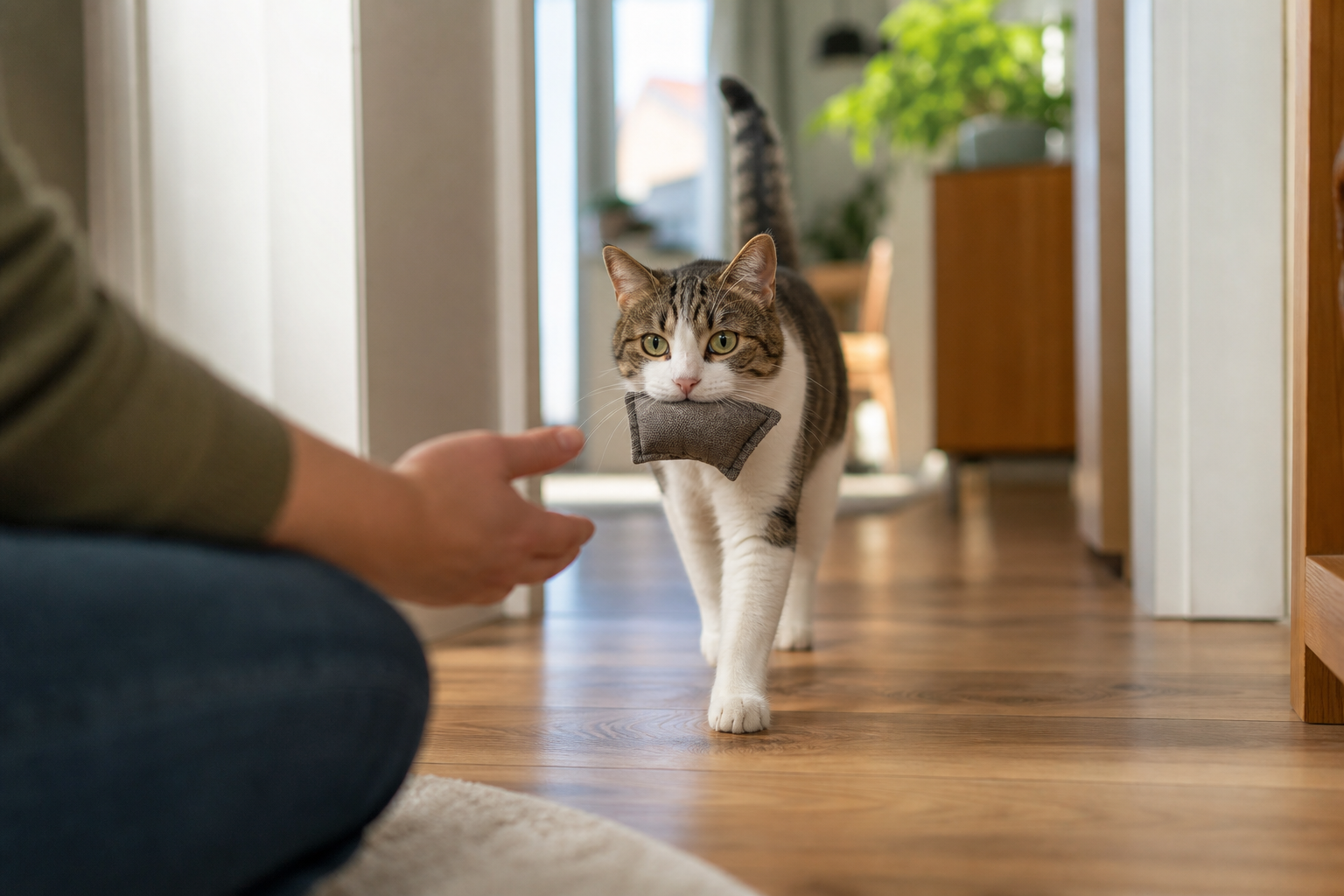
The best cat fetch toy is light enough for your cat to carry, large enough that it cannot be swallowed whole, and simple enough to inspect after every game. A sturdy fabric prey toy, a soft woven ball, or another favorite carry toy can work. Avoid loose strings, detachable feathers, tiny bells, brittle plastic, and anything your cat can chew into swallowable pieces.
You may not need to teach the whole game. Many cats begin fetching on their own: they chase an object, carry it back, and discover that dropping it near a person makes it move again. If your cat only chases—or returns the toy halfway—you can shape the missing step with short tosses and rewards. This guide covers the toy, the training, and the extra safety decisions that matter for rough players.
What Makes a Good Cat Fetch Toy?
A fetch toy has to pass two tests. First, your cat must want to chase and pick it up. Second, it must remain safe through repeated impact, carrying, biting, and dropping. A toy that passes only one test is not a good fetch object.
Look for these features:
- Carryable without being swallowable: your cat should be able to grip part of the toy comfortably, but the entire object should not disappear behind the teeth. There is no universal safe diameter; judge the toy against your own cat’s mouth, chewing style, and determination.
- Lightweight: choose something that lands softly and does not require a hard throw. Heavy balls and dense household objects add unnecessary impact risk.
- A simple shape: fewer tails, glued decorations, clips, bells, and seams mean fewer failure points.
- Visible construction: you should be able to check the surface, stitching, stuffing, and any molded joints before the next toss.
- Enough texture to grip: slick balls may be exciting to chase but impossible to retrieve. A shallow fabric shape or textured ball is often easier to lift.
- A proven preference: begin with an intact toy your cat already carries. Do not assume a product labeled “fetch toy” will outrank your cat’s individual taste.
Cornell Feline Health Center advises avoiding toys with small pieces or strand-like parts such as string and feathers that can separate when chewed and be swallowed. That warning is especially relevant to fetch because the game repeatedly puts the object in the cat’s mouth.
Which types of fetch toys work best?
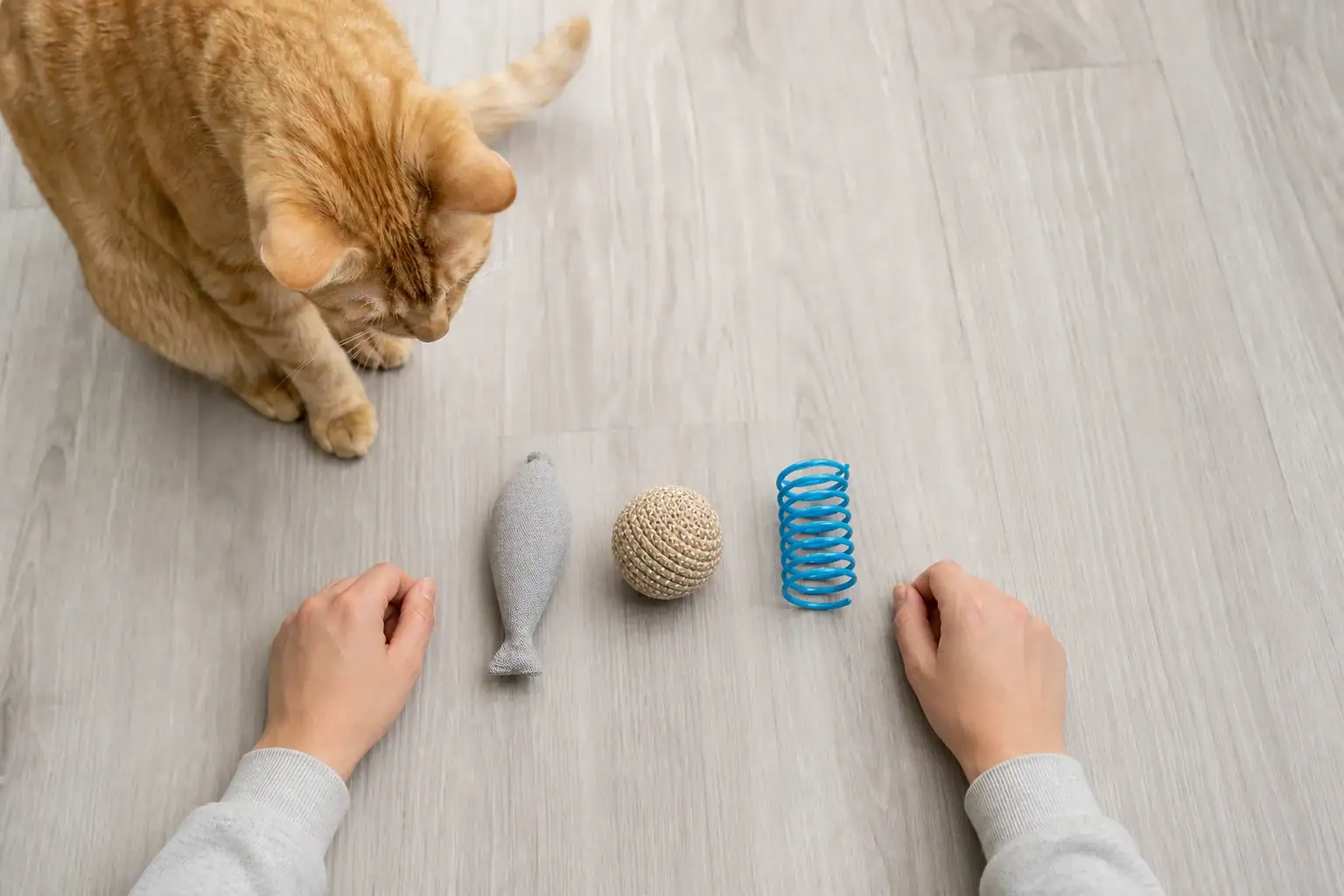
Use your cat’s behavior as the first filter, then apply a safety check. These common options have different strengths and failure points:
- Simple fabric prey toy: often the best starting point for cats that like to carry and wrestle. Choose reinforced seams, minimal decoration, and no exposed stuffing. Retire it when fabric thins, a seam opens, or threads loosen.
- Soft woven or fabric ball: useful for cats that chase rolling movement but need more grip than a smooth ball provides. It still needs to be too large to swallow and resistant to shedding fibers.
- Light plastic cat spring: skitters unpredictably and attracts many chasers. Use only if it is broad enough for your cat, with smooth intact ends, and remove it if chewing creates cracks, sharp edges, or missing pieces.
- Ping-pong-style ball: light, lively, and inexpensive, but better for batting than carrying. It is not a good choice for a cat that punctures or crushes thin plastic. Check it before and after use.
- Plain paper ball: a supervised way to test whether your cat likes the game before buying anything. Use clean, unscented paper with no staples, tape, adhesive, foil, or string, make it too large to swallow, and discard it when it becomes wet or torn.
- Rugged kicker: useful as a reward and physical finish for a rough player, but usually too large for true fetch. Keep it nearby as a handoff if your cat wants to grab and bunny-kick after the chase.
A 2023 Scientific Reports survey of owners of 1,154 fetching cats found that dedicated cat toys were the most frequently named favorite fetch objects, followed by spherical objects and cosmetics. That is a description of preference, not a safety list. Hair ties, rubber bands, makeup items, bottle parts, and other tempting household objects can be swallowed, chewed apart, or contain materials never designed for pet play. Replace an unsafe favorite with a safe toy that mimics its movement, size, or texture without copying its hazards.
If your cat destroys plush toys quickly, use the seam and attachment checks in our durable cat toys guide. Durable means better suited to repeated play—not indestructible or safe to leave out after damage.
Do Cats Naturally Play Fetch?
Fetching is more common than the stereotype suggests, but the available studies measure it in different ways. A 2024 PLOS ONE analysis of 8,224 owner questionnaires classified 40.9% of the cats as fetching sometimes, usually, or always. The authors found that fetching correlated with play and activity, and reports became less likely with age. That percentage describes responses in a large behavior-questionnaire dataset; it should not be treated as a perfect census of every pet cat.
The 2023 Scientific Reports study asked people specifically about cats known to fetch, so it cannot estimate prevalence. It does tell us how the behavior often develops: owners said 94.4% of those cats began fetching without explicit training, the median age when it was first noticed was seven months, and cats initiated and ended sessions more often than people did. Some cats fetched only one specific object, in one location, or with one person.
The practical lesson is to follow the cat’s lead. A cat that carries toys, drops one near you, or runs back after a short toss is already offering part of the behavior. Build on that. A cat that consistently walks away is not failing a test and does not need to be pushed into a dog-style routine.
If your cat already delivers toys while vocalizing, our guide to why cats carry toys and meow can help you read the surrounding body language and decide whether the cat is inviting play, following a learned routine, or showing a change worth discussing with a veterinarian.
How to Teach a Cat to Fetch in Seven Short Steps
Train in a closed, quiet room with a clear floor and no stairs. Keep the first sessions to a few minutes. Choose a reward your cat values—one tiny food reward, praise, petting, or another toss—and stop while the cat still wants more.
- Let the cat choose the object. Place two or three safe options on the floor one at a time. Use the toy your cat repeatedly sniffs, paws, bites, or carries. Too many toys at once can make the choice unclear.
- Reward interest and pickup. Move the toy a few inches away from the cat. The instant the cat touches or lifts it, mark the moment with a clicker or a consistent word such as “yes,” then give the reward. Do not put the object into the cat’s mouth.
- Roll or toss it one to two feet. Send it away from the cat along the floor. A low roll is easier to track and safer than throwing overhead. Mark a chase, then a pickup, as the cat progresses.
- Stay where you are. When the cat picks up the toy, crouch or sit low and invite the cat toward you in a calm voice. Moving toward the cat can turn retrieval into keep-away.
- Reward any movement back. At first, one step toward you counts. Mark and reward that step. Over several repetitions, wait for two steps, then halfway, then a return within arm’s reach.
- Trade for the toy. Reward when the toy reaches you or drops nearby. Never pry it from the cat’s mouth or start a tug match. If the cat keeps possession, pause and offer the reward beside you; end the session if the cat guards the object.
- Add distance slowly. Increase the roll by a foot only after the short return is reliable. Use the same location and cue at first. A hallway can create a simple route, provided it has traction and does not lead toward stairs, doors, people, or other pets.
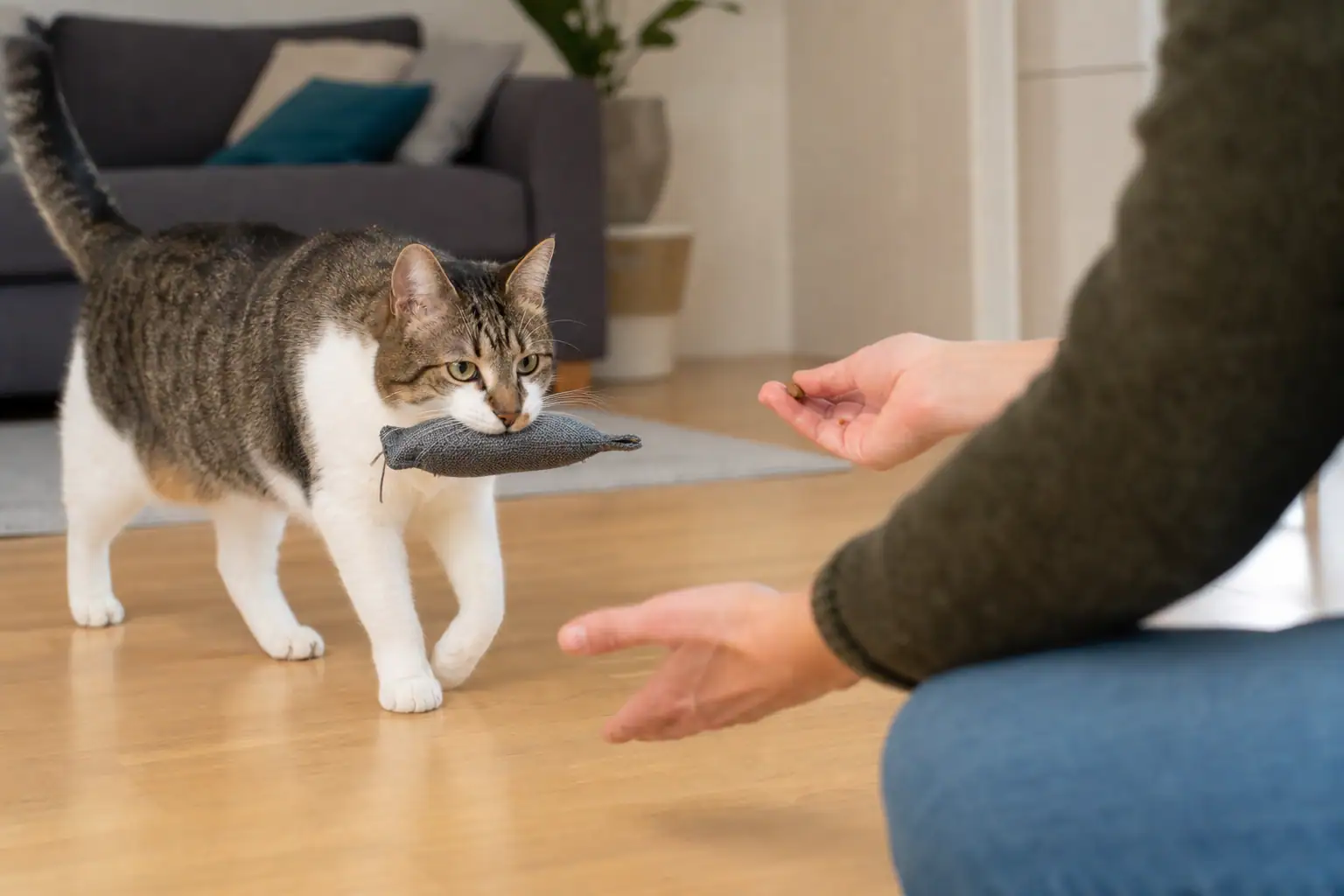
The Feline Veterinary Medical Association’s environmental-needs guidance recommends interactive play that lets cats capture simulated prey intermittently, toy rotation, and positive reinforcement with treats. Fetch can meet part of that need when the cat chooses to participate and gets a real capture. It does not need to become obedience work.
Fix the Part of Fetch That Is Missing
Most cats do not need the entire sequence taught at once. Watch where the chain stops and reward the next small piece:
- Cat watches but does not chase: try a different safe object, make a shorter low roll, add one irregular bounce, or switch surfaces. If interest does not appear, end the attempt.
- Cat chases but does not pick up: reward touching first. Try a shallower fabric toy with an edge that is easier to grip.
- Cat picks up but stays there: remain still and reward a head turn or single step toward you. Do not walk over and repeatedly restart the throw from the landing spot.
- Cat drops it halfway: go to the dropped point after the repetition, shorten the next toss, and reward the shorter complete return. Gradually move your reward location back toward you.
- Cat brings it back but will not release: offer a calm trade. Do not chase, pull, or turn hands into part of the game. Some cats prefer dropping the toy a foot away; that is functional fetch even if it is not a perfect hand delivery.
- Cat fetches only one object or in one room: accept the preference. The research documents highly specific object, place, and partner preferences. Generalizing to a new toy is optional.
- Cat demands fetch at night: end the game with a predictable cue, store the toy out of reach, and schedule an active play session earlier. Do not throw it from bed if you do not want that routine reinforced.
What About Cat Fetch Toy Guns and Automatic Launchers?
Products sold as a “cat fetch toy gun” usually launch a soft disc or propeller for a cat to chase. They may create an exciting chase, but they do not teach retrieval by themselves. Treat them as supervised projectile toys: point away from every person and animal, launch only into a clear floor-level zone, never aim toward the face, and inspect each disc for bite damage or missing pieces after use.
An automatic fetch toy can mean two very different devices:
- An automatic ball launcher throws an object. Many are designed around dog-sized balls, higher forces, or independent loading and may be unsuitable for a cat or an indoor room. Do not use one merely because a marketplace title includes the word “cat.” Confirm the projectile size, weight, range, shutoff, and intended species, and supervise every launch.
- An automatic rolling ball moves under its own power. It can support chase and pounce play, but it is not really a fetch trainer. Check the shell and battery compartment, keep it away from stairs and water, and stop if your cat bites through the casing or becomes overaroused.
For a fuller breakdown of motors, battery doors, collision risks, and rough-player inspection, see our guide to cat toys that move. A hand-rolled toy is the better starting point for fetch because you control the distance, can read the cat’s response, and can stop immediately.
Fetch Safety for Cats That Play Rough
Fetch adds speed and repeated mouthing, so inspect both the route and the toy—not just the cat’s enthusiasm.
- Clear the runway: remove breakables, cords, unstable furniture, and access to stairs. Use a surface with traction and throw away from walls, windows, and other animals.
- Keep the toss low: roll or skim the toy along the floor. Do not make a cat leap blindly toward shelving or furniture.
- Play cats separately: one cat’s chase can become another cat’s ambush or resource conflict. Give each cat an individual turn if competition appears.
- Count food rewards: use tiny pieces and include them in the cat’s normal daily food allowance, especially during repeated training.
- Inspect after every rough session: look for opened seams, wet or thinning fabric, exposed stuffing, loose thread, cracks, sharp edges, and missing pieces. If you cannot account for a missing piece, contact a veterinarian for advice rather than waiting for symptoms.
- Stop before exhaustion: end when movement becomes uncoordinated, the cat loses interest, the tail lashes, ears flatten, or play redirects onto hands. Never use panting as a fitness target.
Stop the game and contact your veterinarian if fetch is followed by limping, persistent open-mouth breathing, collapse, coughing, obvious pain, or a sudden change in willingness to run or carry objects. A cat that compulsively chews or swallows non-food objects also needs individual guidance; a tougher toy does not solve the cause of pica-like behavior.
For broader chase-and-capture options, use the selection framework in our cat toys for hunting guide. Fetch is one enrichment game, not a requirement. A cat that prefers stalking, batting, foraging, or wrestling can get an equally valuable play session without returning anything.
Quick Cat Fetch Toy Checklist
- Does my cat already choose, carry, or chase this object?
- Can my cat grip it without fitting the entire toy in the mouth?
- Is it lightweight enough to land softly?
- Is it free of string, feathers, bells, glued eyes, clips, and other detachable parts?
- Can I inspect every seam, surface, joint, and battery door?
- Is the floor route clear, stable, and away from stairs and other pets?
- Am I using a short low toss instead of throwing toward the cat?
- Will I reward one small return step instead of forcing a full retrieve?
- Does my cat remain relaxed and willing to continue?
- Will I store or retire the toy as soon as damage appears?
A good cat fetch toy is not the flashiest launcher or the object that travels farthest. It is the safe, inspectable toy your cat wants to bring back. Start with one or two feet, reward the part your cat offers, and let the cat decide when the game is over.
Sources
- Forman, Renner, and Leavens (2023): Fetching felines—survey of cat owners on fetching behavior
- Delgado et al. (2024): Prevalence and characteristics of fetching behavior in owned cats and dogs
- Cornell Feline Health Center: Safe toys and gifts
- Feline Veterinary Medical Association: Your Cat’s Environmental Needs
Leave a Reply