
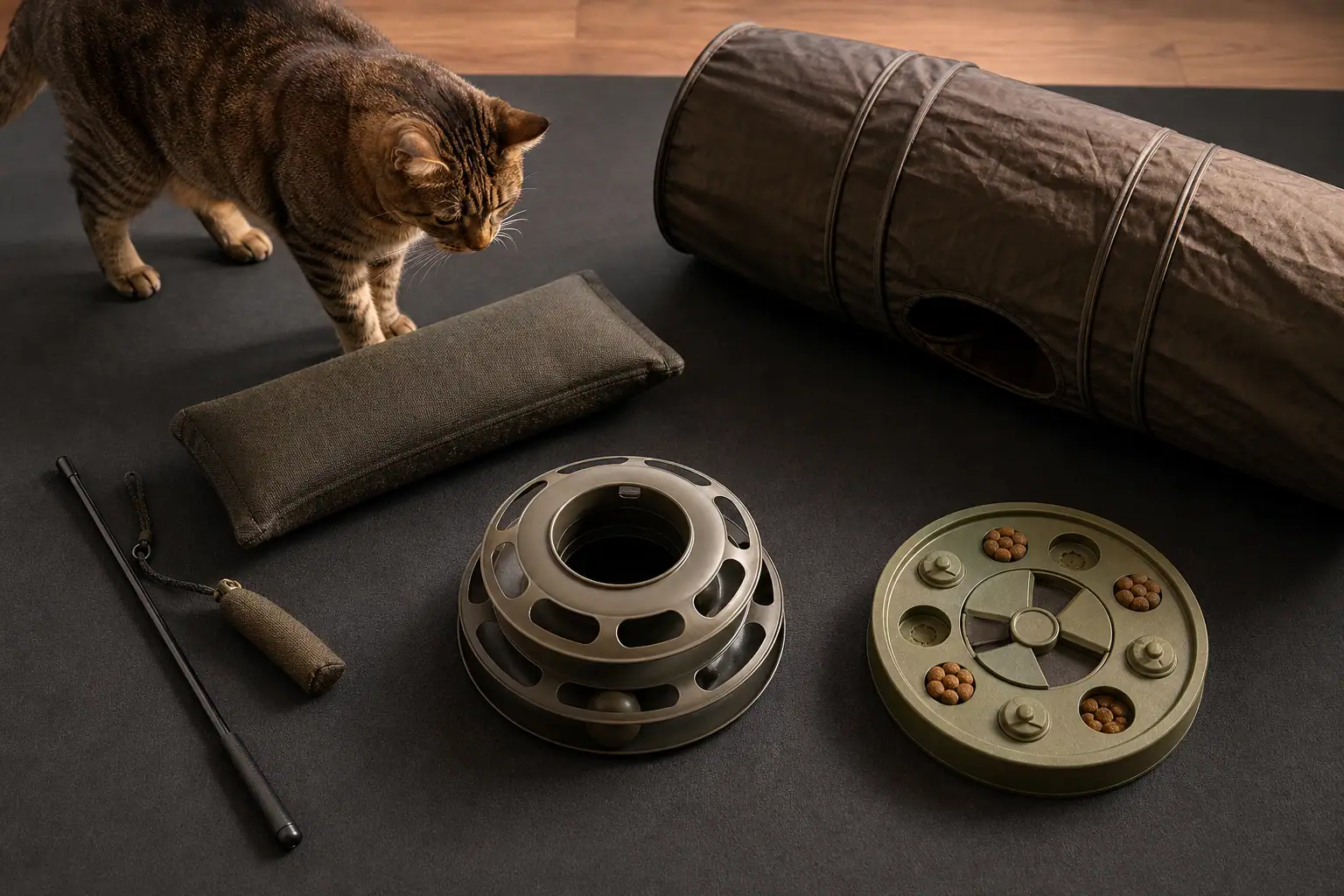
The best cat toys for adult cats are a mix of interactive chase toys, large capture toys, simple batting toys, food puzzles, and hiding or ambush toys. You do not need a basket full of novelty. Start with five different jobs: a wand for stalking and chasing, a sturdy kicker for the catch, an enclosed track or oversized ball for solo movement, an easy puzzle for foraging, and a tunnel or box for hiding and ambushing.
Choose the exact toy by what your cat does—not by the age printed on a package. An adult cat who waits behind furniture needs a different target from one who charges, grabs, and bunny-kicks. Let the cat catch the moving lure, keep risky parts under supervision, rotate a small selection, and inspect every toy that receives hard bites.
Best cat toys for adult cats at a glance
This table is a starting kit, not a universal ranking. Watch two or three play sessions before deciding which category deserves a permanent place in your home.
| Toy type | What it lets the cat do | Best fit | Access rule |
|---|---|---|---|
| Wand or fishing-pole toy | Watch, stalk, chase, leap, and catch | Most adult cats; especially social hunters | Supervised; store the entire toy after play |
| Large fabric kicker | Grab, bite, wrestle, and bunny-kick | Physical cats and rough players | Supervise until seams and chewing habits are proven |
| Enclosed ball track or oversized ball | Swat, chase, and repeat a cause-and-effect action | Independent batters and short-burst players | May be suitable to leave out after testing |
| Stable food puzzle | Search, paw, manipulate, and eat a reward | Food-motivated cats and indoor cats needing variety | Use measured food; begin with an easy stationary design |
| Wide tunnel or handle-free box | Hide, investigate, ambush, and retreat | Cautious stalkers and cats that like cover | Remove wire, loops, handles, staples, tape, and torn material |
The categories work together. A wand creates distance and prey-like movement; a kicker gives the adult cat something substantial to hold when the chase ends. A track or ball allows a quick game without a person. A puzzle turns part of a normal meal into a search. A tunnel changes the room itself by adding cover and a route.
Adult cats do not outgrow play. VCA’s veterinary behavior guidance notes that adult cats retain the ability and motivation to hunt and benefit from regular playful interaction. The important change from kittenhood is not that play becomes optional; it is that individual preferences, strength, health, and learned habits become clearer.
Match toys to your adult cat’s hunting style
Ignore what a toy is called for a moment and watch your cat’s first move. That first move is a better buying guide than a long list of “best” products.
- The watcher: crouches, freezes, and tracks small motion before acting. Drag a wand lure slowly along the floor, let it disappear behind a box, and pause. A tunnel or low cardboard barrier makes the game more convincing.
- The chaser: accelerates after rolling or fleeing objects. Use an oversized ball on a clear floor or a wand moving away from the cat. Do not wave the lure repeatedly into the cat’s face.
- The leaper: follows airborne movement and uses vertical space. Use a wand with controlled low arcs and safe landings. Avoid high repetitive jumps on slippery floors.
- The grabber: closes distance, wraps the front legs around the target, bites, and kicks. Finish a chase with a long kicker that keeps teeth and rear claws away from hands.
- The fisher: reaches under doors, rugs, and furniture. Try a stable puzzle board, hunt box, or toy moving partly behind cover. Openings must not trap the head or paw.
- The forager: investigates food scents and persists at small problems. Start with food visible in a shallow puzzle, then increase difficulty one step at a time.
Many cats combine styles. Use the sequence they naturally offer: a watcher may stalk for two minutes, sprint for ten seconds, then become a grabber. A satisfying toy session should allow those transitions instead of demanding nonstop running.
The joint AAFP and ISFM feline environmental-needs guidelines recommend opportunities for play and predatory behavior, including searching, stalking, chasing, pouncing, catching, and manipulating. That is the reason to build a small system rather than look for one magical toy.
Build a five-toy adult cat kit
Use this order if you are starting from scratch or replacing a pile of ignored toys.
- Choose one interactive lure. Look for a comfortable handle, enough distance between hands and claws, and a lure that can be replaced or inspected. Reserve it for owner-led play and lock it away afterward.
- Add one physical catch. Pick a kicker long and wide enough for your cat to hold against the chest while kicking. Favor simple shapes, dense construction, reinforced seams, and minimal decoration.
- Add one tested solo mover. An enclosed ball track is often easier to assess than a motorized gadget. An oversized smooth ball can work if it is too large to swallow and the cat cannot peel its material.
- Add one easy food problem. Use a stable, washable puzzle with food visible at first. Load it with part of the cat’s measured meal—not bonus calories that silently accumulate.
- Add one piece of cover. A wide tunnel or plain cardboard box can support hiding, ambush, rest, and route changes. Remove bag handles and any material your cat tries to eat.
This kit can be inexpensive. Movement, size, placement, and timing matter more than electronics. A paper ball too large to swallow, an open box without tape or staples, and kibble placed in an easy egg-carton puzzle can reveal a preference before you spend more. Supervise homemade items, especially if your cat chews cardboard, foam, paper, fabric, or glue.
For more solo options and a detailed leave-out test, see our guide to self-play cat toys. If the cat opens seams or dismantles plush toys, use the construction criteria in our durable cat toy guide. “Durable” means better matched to the cat’s force and attack style; it never means damage-proof.
Run a satisfying 10-minute play session
A short session can be useful if it has structure. The goal is not to exhaust the cat. It is to make the target behave like something worth hunting and let the cat succeed.
- Minute 0–2: wake the hunt. Begin when the cat is already alert. Move the lure away at floor level, pause behind furniture, and wait for orientation. Do not poke or corner the cat.
- Minute 2–6: alternate pursuit and pause. Use short escapes, cover, and direction changes. Let the cat watch between bursts. Keep jumps low enough for safe landings.
- Minute 6–8: allow several catches. Relax the lure when caught. Do not yank it instantly from the cat’s mouth or paws. Restart only when the cat releases and remains interested.
- Minute 8–9: offer the final capture. End at a kicker, fabric prey toy, or small portion of the normal meal so the cat can hold or consume the result.
- Minute 9–10: cool down and inspect. Let movement fade, put corded toys in closed storage, and check the catch toy for damage.
Ten minutes is a format, not a prescription. Some adult cats want three focused minutes; others want several rounds. Stop when the cat walks away, hides, pants, becomes frantic, or stops re-engaging. Our cat play schedule guide explains how to adjust session number and length for energy, age, health, and response.
Do not use hands, feet, or moving toes as prey. Redirect stalking and grabbing to a toy with distance. Always let a cat physically catch a wand lure; if you use a laser, transition to a tangible target or food reward instead of ending with an uncatchable dot.
Rotate toys without constantly buying new ones
Adult cats often stop responding to an unchanged object even when they still want to play. A controlled study of object play and habituation in adult domestic cats found that play declined across repeated presentations of the same toy and increased when sensory features changed. Rotation creates renewed contrast without requiring a stream of purchases.
Try a simple three-bin system:
- Active: two or three toys available now, each with a different job.
- Interactive storage: wands, strings, feathers, elastic, and fragile lures used only with a person.
- Resting: cleaned, intact toys kept out of sight for several days before returning.
Swap one active toy every three to seven days, or sooner if your cat ignores it. Change only one variable when an old toy returns: location, time of day, movement, or the cover around it. A track beside a box may be interesting even if the same track in an empty room was not.
A large survey of cat guardians found that offering a greater variety of games was associated with higher guardian-reported feline quality-of-life scores, although the design cannot prove that variety alone caused the difference. The study on play and cat welfare supports a practical point: pay attention to both the number of minutes and the range of experiences you offer.
Clean food-contact toys after use and inspect fabric, plastic, fasteners, and openings as you rotate. Our cat toy cleaning guide separates washable items from toys that should be retired rather than scrubbed back into service.
Safety rules for adult cats that play rough
An adult cat can apply more force and use a more practiced attack sequence than a kitten. A toy that survives gentle batting may fail when pinned, chewed, twisted, and raked. Safety depends on the exact cat-toy interaction, not on a package claim.
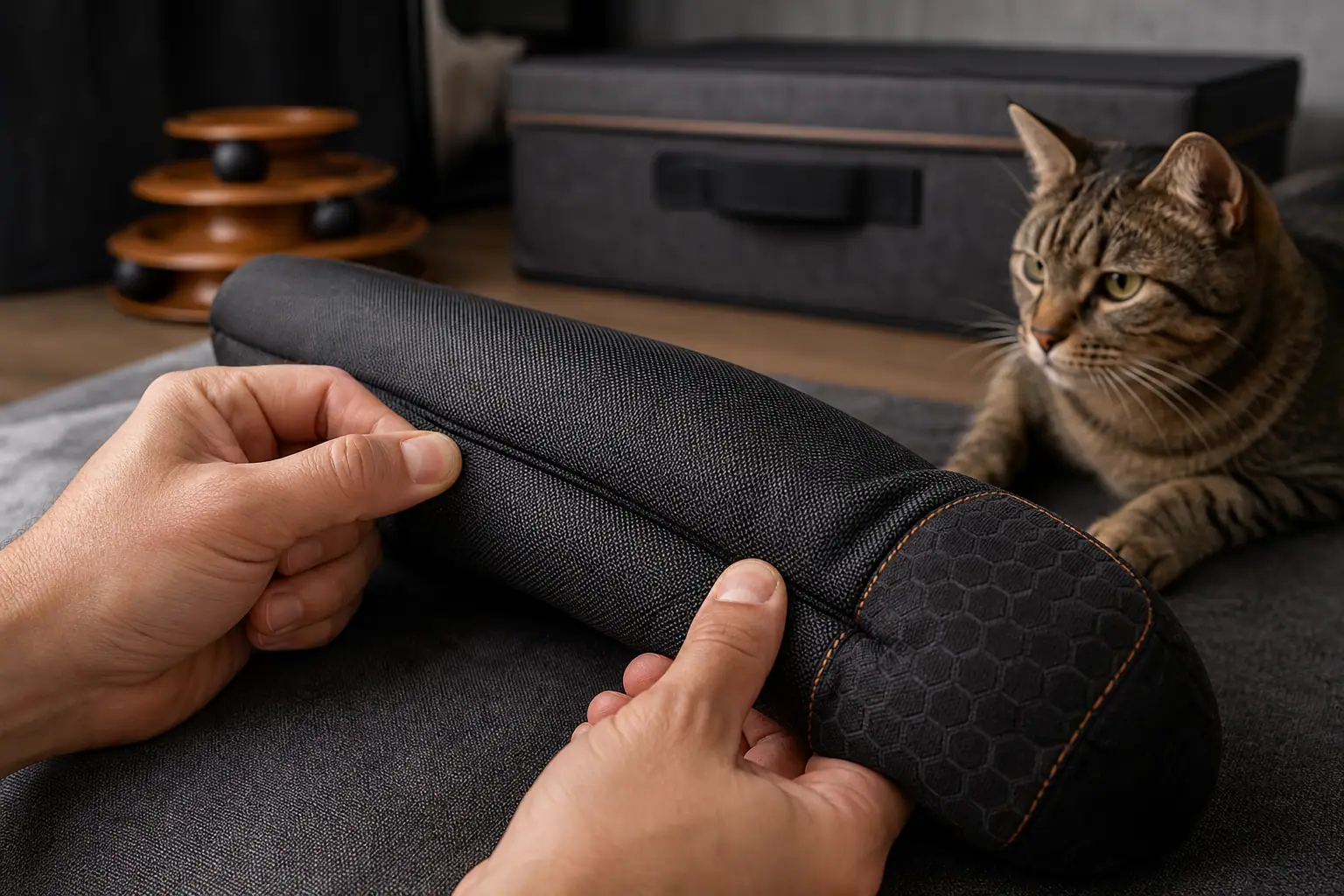
Use three checks every time a new toy enters the rotation:
- Before play: tug attachments, flex plastic, press battery doors, check seams from end to end, and remove packaging. Reject sharp edges, exposed wire, loose thread, glued-on eyes, easy-to-remove bells, and pieces small enough to swallow.
- During play: watch whether the cat bats, carries, chews, saws at one seam, or tries to reach the mechanism. A toy safe for chasing may not be safe for sustained biting.
- After play: account for every part. Retire the toy if its shape changes, a seam gaps, fabric thins, stuffing appears, plastic cracks, a rattle moves toward an opening, or a component becomes loose.
Store string, ribbon, yarn, elastic, feathers, wire, tinsel, and wand toys in a closed container after use. Cat Friendly Homes, an initiative of the Feline Veterinary Medical Association, specifically warns that string-like items are easily swallowed and can cause serious intestinal injury.
If a piece is missing and ingestion is possible, call a veterinarian promptly. Do not wait for a dramatic symptom and never pull visible string from a cat’s mouth or rear. Vomiting, appetite loss, lethargy, hiding, abdominal discomfort, straining, or changes in stool after access to a damaged toy require urgent veterinary advice.
When a toy problem may be a health problem
Do not label an adult cat lazy because a popular toy fails. The toy may move too quickly, make an unpleasant sound, sit in an exposed location, demand painful jumping, or compete with another cat. Make the game slower and easier, add cover and traction, and offer individual play in a calm room.
A sudden or sustained decline in play is different. Contact a veterinarian if reduced play appears with limping, stiffness, reluctance to jump, hiding, irritability, weight or appetite change, vomiting, increased thirst, litter-box changes, overgrooming, or difficulty gripping food and toys. Dental pain, arthritis, vision change, illness, and stress can all change play; a new gadget cannot diagnose the cause.
Adult and senior are not interchangeable. If your cat has become slower, less flexible, or more easily startled, choose stable floor-level targets, nonslip surfaces, gentle arcs, and large easy-to-grip toys. Our senior cat toy guide offers a comfort-first selection process and signs that merit a veterinary visit.
Adult cat toy checklist
- Start with five jobs: chase, capture, solo movement, foraging, and cover.
- Match toys to the cat’s first move: watch, chase, leap, grab, fish, or forage.
- Let the cat stalk, pause, catch, and walk away; do not force constant motion.
- Keep hands and feet out of predatory games.
- Store all string-like and fragile toys after supervised use.
- Use measured food and easy success when introducing puzzles.
- Rotate two or three active toys instead of leaving the whole collection out.
- Inspect before, during, and after rough play.
- Retire damaged toys immediately; durability is never a lifetime guarantee.
- Ask a veterinarian about sudden play changes or signs of pain or illness.
What toys do adult cats like most?
Many adult cats respond best to prey-like movement they can stalk and catch, but the preferred movement varies. Watch whether your cat waits, chases, leaps, grabs, fishes, or works for food, then choose a toy that rewards that behavior. A wand plus a substantial catch toy is the most versatile starting pair.
How many toys should an adult cat have?
A collection of five distinct toy types is enough to build a useful rotation. Leave out only two or three tested options at once and store interactive or fragile toys. Variety of function matters more than the total number in the basket.
What is the best toy for an indoor adult cat?
There is no single best toy. A balanced indoor setup combines owner-led hunting, a safe physical catch, a simple self-play option, and a food-search activity. Add cover, climbing, scratching, and rest to support the wider environment; our cat enrichment guide shows how those pieces fit together.
Why does my adult cat ignore new toys?
The toy may not match the cat’s preferred movement, may be too exposed or noisy, or may never produce a catch. Introduce one item at a time, make the first success easy, and change timing or location before buying again. If loss of interest is sudden or broad, arrange a veterinary check.
Bottom line: the best cat toys for adult cats form a small, flexible system. Choose by behavior, give every chase a catch, separate supervised toys from leave-out options, rotate for novelty, and treat inspection as part of every hard play session.
Editorial note: This guide provides general enrichment and toy-safety information. It does not replace advice from a veterinarian who knows your cat’s health, diet, mobility, and ingestion history.
Leave a Reply