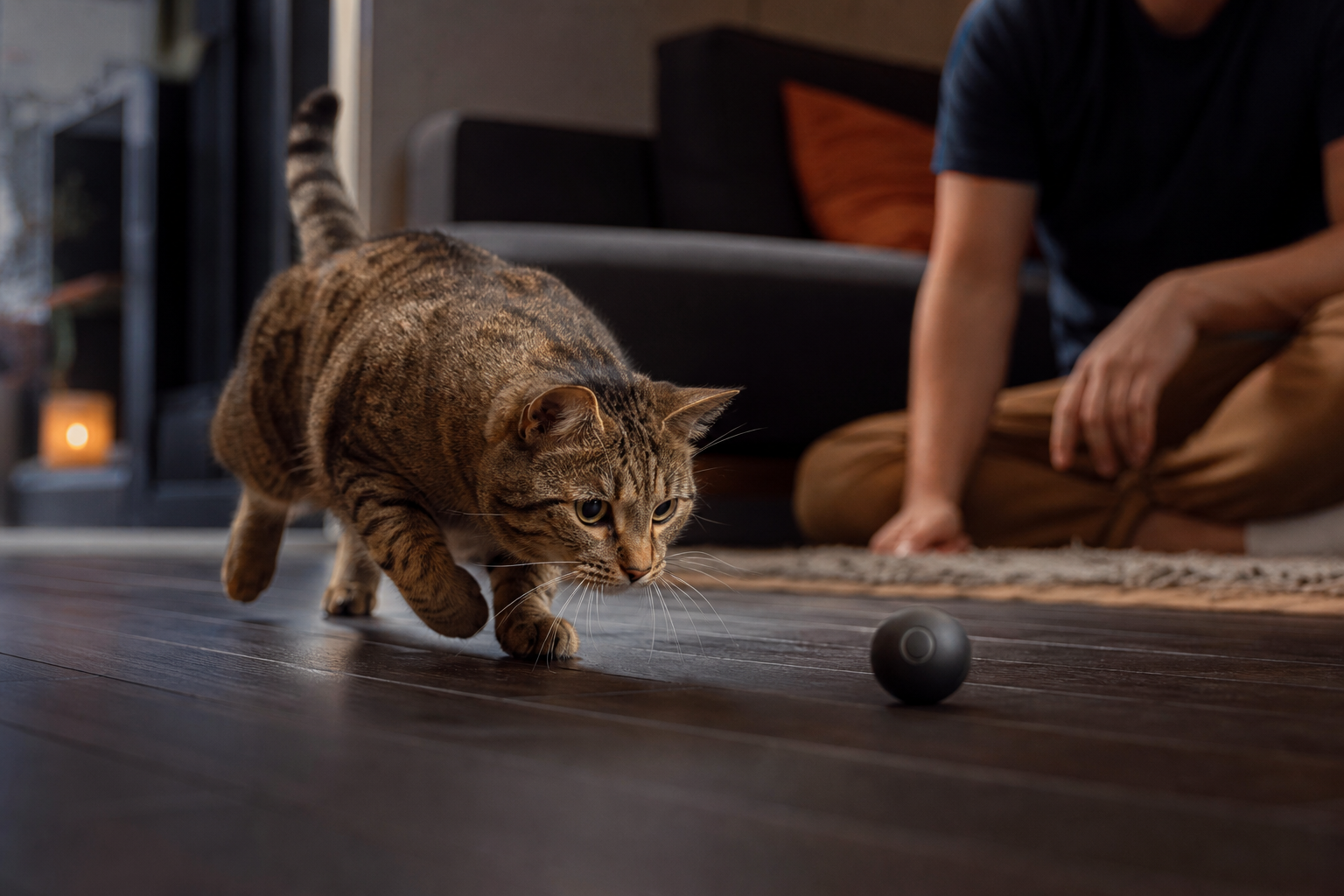
Rechargeable cat toys are worth considering when they create the kind of movement your cat already enjoys and keep the battery, motor, port, and moving parts out of reach. A rechargeable rolling toy may suit a ground chaser; a covered-motion toy may suit a patient stalker; and a flapping plush may suit a wrestler only if its removable electronic module remains fully enclosed. Rechargeability saves disposable-battery changes, but it does not make a toy safer, more durable, or more interesting by itself.
Choose by mechanism and construction before comparing charge time or advertised runtime. Look for a rigid intact housing, protected charging port, clear input instructions, short automatic play cycles, an accessible off switch, cleanable surfaces, and replacement lures or covers where relevant. For a cat that bites housings, tears seams, or pulls attachments free, keep every powered toy supervised.
This guide does not name a universal “best rechargeable cat toy.” Cats, floors, and failure patterns vary too much for that. Instead, it gives you a practical way to compare electronic interactive cat toys and reject a poor fit before it becomes an expensive object under the sofa.
Rechargeable cat toys at a glance
The battery solves only one part of the ownership problem. The better question is whether the whole device delivers catchable, varied play without creating a new chewing, trapping, cleaning, or charging hazard.
| Type | Often suits | Strong buying signal | Main failure point |
|---|---|---|---|
| Self-rolling ball or mouse | Ground chasers and short-distance sprinters | Smooth oversized shell, useful low-speed mode, stops when pinned | Cracked seam, loose cap, wheel gap, inaccessible dirt |
| Covered-motion or peekaboo toy | Stalkers that wait, watch, and swat | Low stable base, unreachable drive shaft, replaceable wide lure | Fabric pulled into mechanism or paw reaching moving parts |
| Rotating wand or concealed tail | Cats attracted to erratic circular movement | Wide stable base, short timer, sturdy replaceable target | Feather, elastic, wire, or connector detaching |
| Flapping plush or kicker | Grabbers and rabbit-kickers | Simple washable cover and fully enclosed removable module | Opened seam or flap exposing the hard electronics |
| Remote-control vehicle | Social hunters that respond to owner-driven routes | Responsive controls, enclosed wheels, slow mode, repair support | Small accessories, wheel pinch points, impacts, lost cable |
| Automatic laser | Some visually motivated cats | Known laser classification, controlled beam path, short timer | No physical catch, unsafe beam or reflection, repetitive pattern |
If you are still deciding among mechanisms, start with our broader electronic cat toy safety guide. Rechargeable power is a feature within that category, not a separate play style.
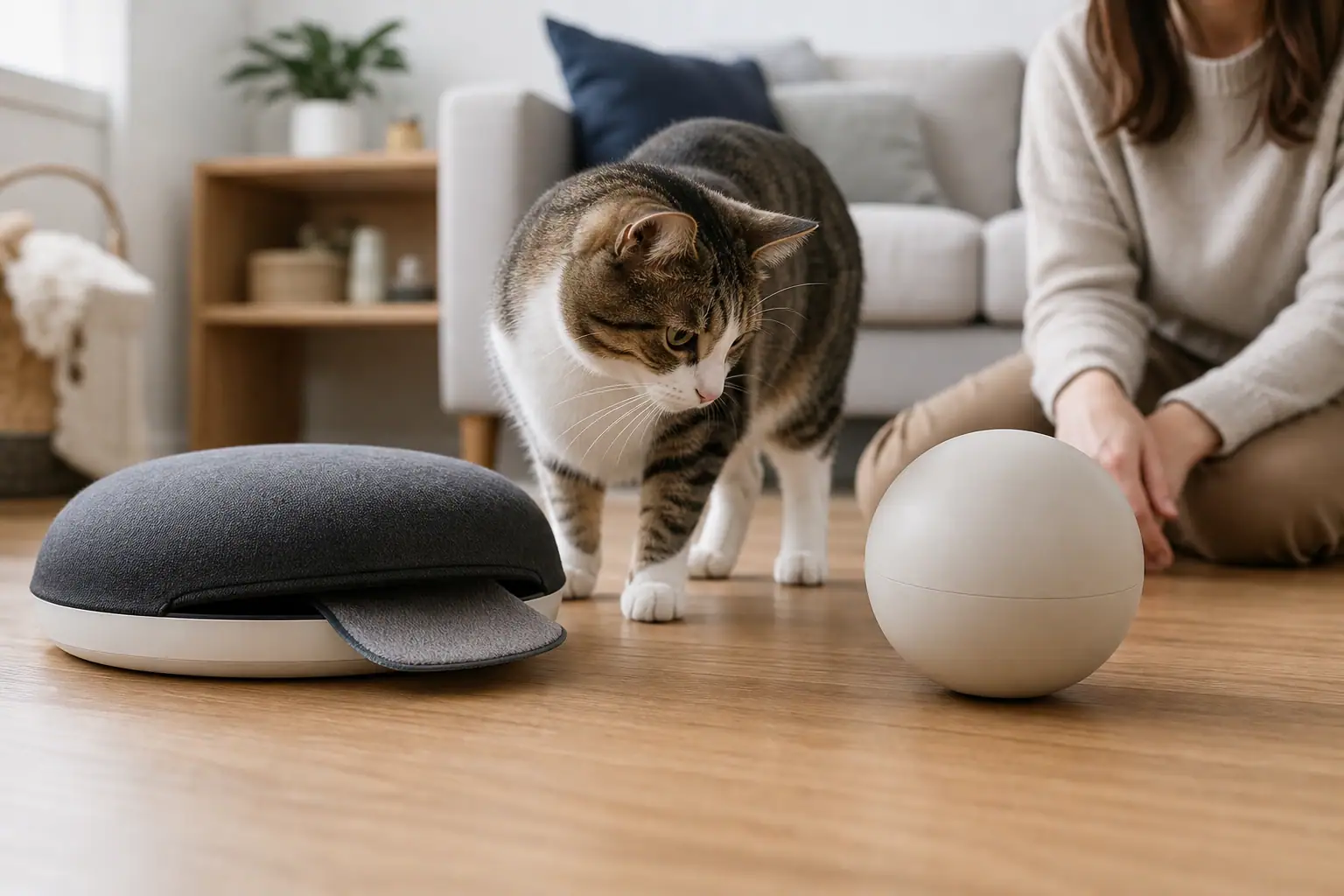
Choose the movement your cat wants to catch
Watch your cat play with simple toys before shopping. Does the cat stare under doors, sprint after tossed objects, leap at airborne lures, or clamp and kick a fabric toy? That answer predicts useful motion better than a product page full of modes.
For a stalker: covered motion
A target that disappears beneath a mat or into openings creates pauses and uncertainty. Confirm that a paw cannot reach the drive arm, gears, or attachment socket. A broad fabric strip is easier to inspect than a bundle of thin feathers. The base should stay flat when struck rather than revealing its underside.
For a sprinter: a rolling toy
Test the slowest mode first on your actual flooring. A ball that is lively on carpet may ricochet on tile, disappear beneath appliances, or frustrate a cat in a cluttered room. Look for a shell too large to swallow, a reliable stop response, and no decorative ears, tail, cap, or loop that can be bitten off.
For a wrestler: a flapping plush
The cover is a barrier between teeth and a hard battery module. Check its closing flap, zipper, motor pocket, wing or fin seams, and every glued detail. A removable module helps with cleaning only when the pocket closes securely and the cover dries completely before reassembly. Cats that rapidly open plush seams need a separate unpowered kicker for the catch.
For responsive play: remote control
Owner control can make movement more prey-like: flee briefly, pause behind furniture, reverse, then allow capture. Wheels and axles should not trap fur or toes, and the toy should stop instead of continuing to drive when pinned. Our remote control cat toy guide covers room setup and driving technique in more depth.
The Feline Veterinary Medical Association’s environmental-needs guidance recommends opportunities for play and predatory behavior and says cats should be able to capture the “prey” intermittently. If the powered target cannot safely be grabbed, direct the final pounce to a physical toy or small food reward that suits the cat.
Check these seven details before you buy
- Exact charging instructions: the listing or manual should state the port type, expected input, charge indicator behavior, and when to disconnect. “USB rechargeable” alone is incomplete.
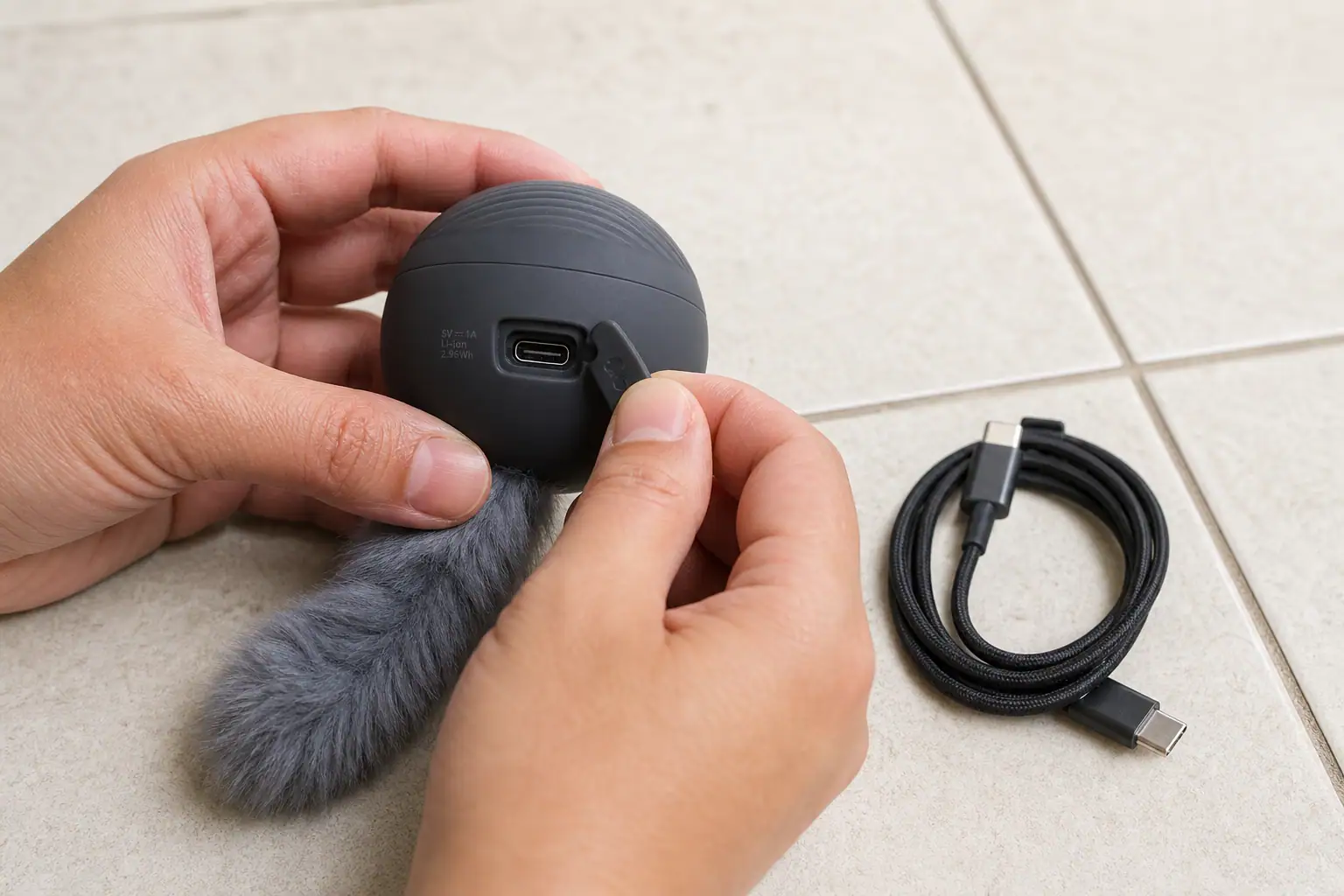
- Protected cell and port: the internal battery should not be removable by the cat. The charging port should be recessed or covered and should not sit where teeth, claws, saliva, or floor impacts reach it first.
- Useful controls: prioritize a physical off switch, a calm or low-speed mode, and a short timer over a long list of flashy patterns. Check whether motion activation can be disabled.
- Failure behavior: find out what happens when the toy is pinned, hits a wall, catches fabric, or becomes low on power. A motor that keeps straining is a poor match for a cat that tackles hard.
- Cleanability: hair will collect around wheels, shafts, fabric openings, and seams. Instructions should explain what can be wiped, removed, or washed without wetting the electronics.
- Replaceable wear parts: a replaceable cover or broad lure can extend useful life. Skip thin strings, exposed elastic, tiny screw-on caps, and attachments that are unavailable from the maker.
- Seller and maker support: look for a real manual, model number, contact details, warranty terms, and replacement guidance. Save the instructions and order record.
Do not equate a long runtime with better enrichment. A cat may engage for a few focused minutes and ignore the remaining battery. Session length, predictable shutoff, and convenient recharging matter more than the largest hour count on the box.
Use a safer charging routine
Charge the toy as an electronic device, not as part of play. The cat should never have access to the cable or toy while it is plugged in. Cornell’s cat-toy guidance specifically advises avoiding accessible electrical cords and toy parts that may separate and be swallowed.
A six-step charge-and-check routine
- End the session and switch off: let the toy cool to room temperature if it has been running or sitting in direct sun.
- Inspect while unplugged: reject a cracked or distorted case, loose port, frayed cable, bent connector, moisture, unusual odor, rattling internal part, or visible swelling.
- Move to a cat-free station: use a clear, dry, nonflammable surface away from bedding, paper, curtains, food, water, and direct heat.
- Follow the product instructions: use the supplied cable and the specified compatible power source. Label the cable so it is not casually swapped with one whose connector merely happens to fit.
- Stay present: do not charge while asleep or away. Disconnect when the indicated cycle is complete rather than leaving the toy plugged in indefinitely.
- Check before play: unplug, close any port cover, confirm the casing is cool and dry, remove the cable from the room, and run one cycle without the cat.
The U.S. Consumer Product Safety Commission’s guidance for rechargeable toys recommends adult charging, following the manufacturer’s instructions, staying present, using a nonflammable surface, disconnecting after charging, and immediately stopping use after damage. Those precautions are sensible even though a small cat toy uses less energy than the flying toys addressed in the alert.
If the toy becomes hot, swells, hisses, leaks, smokes, smells sharp or sweet, or behaves unusually, do not handle it casually or try another cable. Keep people and animals away, follow local emergency guidance if there is heat, smoke, or fire, and ask the manufacturer or local battery-disposal service how to manage a damaged unit.
Durability rules for cats that play rough
No rechargeable cat toy is indestructible. In fact, electronics add several likely failure points: a port, case seam, switch, wheel or shaft opening, removable module, and attachment socket. Decide whether the powered toy is meant to be chased, caught, or wrestled—and do not ask a chase-only housing to survive as a chew toy.
- Plastic gnawer: avoid raised buttons, rubbery port flaps, thin translucent shells, and exposed wheel hubs. Use under direct supervision.
- Attachment puller: remove products with feathers, narrow elastic, wispy tails, or tiny connectors from the shortlist. Choose a wide replaceable target.
- Plush opener: inspect the module pocket and every perimeter seam before and after play. Retire the cover when it no longer closes completely.
- Full-body tackler: choose a low stable device that stops when pinned. Listen for a new rattle, grind, or pitch change after impact.
- Carrier and hider: choose a device too large to carry into water, drop down stairs, or wedge behind an appliance. Block dangerous gaps during play.
For a cat that attacks the casing, use the motor only to start the hunt, then switch to a simpler capture toy. The Titan Claws durable cat toy guide helps identify whether your cat usually defeats seams, fabric, attachments, or hard housings.
Turn battery life into better play, not more play
A rechargeable toy can run repeatedly without consuming disposable cells, but constant availability quickly makes one motion ordinary. Short, varied sessions preserve novelty and give you a chance to inspect the device.
- Set the room: block stairs and appliance gaps; move cords, liquids, breakables, and unstable objects.
- Present it switched off: allow sniffing and retreat. Never place a buzzing toy against a hesitant cat.
- Start low and slow: use brief movement with pauses. Watching and stalking count as engagement.
- Build a catch: let a safe wide lure stay pinned, or redirect the final pounce to an unpowered kicker or food puzzle.
- Stop before fatigue: end on a successful catch while body language is still loose. Some cats want three minutes, not fifteen.
- Inspect, clean, and rotate: check every seam and opening, wipe as directed, then store the powered toy and cable separately.
Rotate it with owner-led wand play, boxes, tunnels, climbing, scratching, food puzzles, and quiet exploration. If new gadgets keep losing their novelty, use our seven-day play reset for bored cats before buying another device.
Can a rechargeable cat toy run while you are away?
Rechargeable does not mean safe for unattended play. A timer conserves power; it cannot prevent a chewer from opening a seam, a lure from detaching, a rolling toy from reaching stairs, or conflict between cats.
Only consider leave-out access when every answer is yes
- Has this exact cat used this exact toy calmly in several supervised sessions?
- Are the battery, port, switch, wheels, motor, and attachment socket inaccessible to teeth and paws?
- Is there no reachable string, feather, elastic, wire, small cap, or detachable decoration?
- Does the toy stop reliably when pinned and after a short cycle?
- Is the charging cable unplugged and stored in a closed location?
- Is the play area free of stairs, water, unstable objects, cords, and gaps where the toy or cat could become trapped?
- Would the switched-off object still be safe to leave with this cat’s known chewing and dismantling habits?
If one answer is no, store the toy when you leave. Cats that destroy toys, swallow non-food objects, or turn powered housings into wrestling targets need supervised use. For a fuller room-by-room assessment, see automatic cat toys for when you are away.
Replacement signs and quick answers
Retire a rechargeable toy when the case cracks or separates; the port or switch loosens; a cover no longer closes; a wheel, shaft, or lure binds; the motor sound changes; the battery drains abnormally fast; the unit becomes warmer than usual; or there is swelling, moisture, leakage, smoke, or an unexplained odor. Do not donate a damaged electronic toy. Follow the maker’s directions and local rules for battery or electronics disposal.
Count detachable parts after hard play. If a battery, plastic fragment, fabric tab, string, wire, foam piece, or other component is missing—or if your cat bit into a battery module—contact a veterinarian or emergency veterinary service promptly. The ASPCA Poison Control service also provides 24/7 guidance for possible animal poison exposures; a consultation fee may apply. Bring the product, manual, or packaging information if you can do so safely.
Are rechargeable cat toys better than toys with disposable batteries?
They reduce routine battery changes and may cost less to power over time, but they add an internal cell, charging port, cable, and charge cycle. Compare the entire toy. A simple replaceable-battery device with a tool-secured compartment may be a better fit than a poorly enclosed rechargeable one.
Is USB-C automatically safer or faster?
No. USB-C describes the connector, not the toy’s overall battery quality, charging controls, durability, or compatibility with every power source. Follow the model’s stated input and charging instructions, and keep its supplied cable labeled.
How long should a rechargeable cat toy run?
Use the cat’s engagement and body language, not the maximum battery runtime, to set the session. Start with a few slow minutes, add pauses and a physical catch, and stop while the cat remains comfortable. The automatic shutoff is a backstop, not a goal.
What is the best rechargeable cat toy for a cat that destroys toys?
Often it is a low, smooth, fully enclosed chase device paired with a separate durable kicker for grabbing—both supervised. Avoid plush motor pockets, thin attachments, exposed wheels, raised port covers, and small caps when those match your cat’s usual failure pattern.
Can I wash a rechargeable cat toy?
Only as its instructions permit. Some plush covers can be removed and washed after the module is taken out; many housings can only be wiped. Never immerse electronics, charge a damp unit, or reinstall a module into a cover that is not completely dry.
Editorial note: This article provides general toy-selection, charging, and enrichment guidance. It does not replace product instructions, local fire-safety guidance, or veterinary care after suspected ingestion, burn, electrical exposure, or other injury.
Leave a Reply