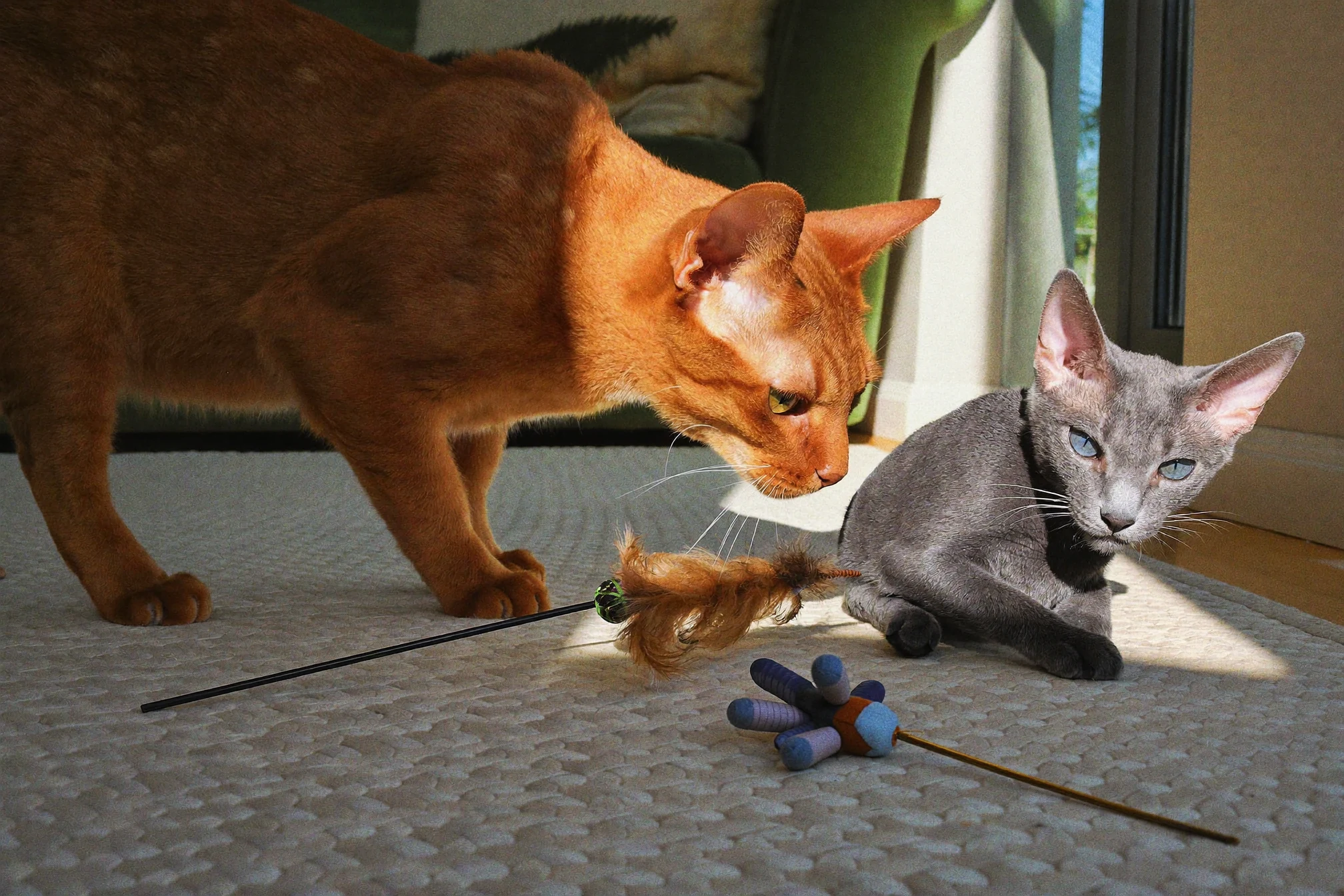
A realistic cat toy for a real cat should behave like prey without adding fragile details that make it unsafe. The useful realism is in the movement: a mouse-sized target that slips behind cover, a lure that flutters and lands, or a catch that pauses long enough to stalk and grab. Photographic fur, plastic eyes, thin tails, and decorative feathers may look convincing to a person while giving a rough-playing cat weak points to chew.
This guide is specifically about prey-style toys for cats. It does not cover lifelike plush or robotic companion pets made for people. Choose the format by the way your cat hunts, insist on a satisfying physical catch, and inspect the toy before and after every hard session.
For a real cat, movement matters more than perfect looks
Cats do not need a museum-quality mouse. A useful realistic cat toy behaves like catchable prey: it appears at the edge of cover, pauses, moves away rather than charging at the cat, and eventually gets caught. Texture and size should support grabbing without adding easily swallowed decoration.
VCA Animal Hospitals’ play guidance recommends predatory games with toys a cat can ultimately catch and “kill,” while monitoring play so non-food items are not consumed. That makes catchability a more valuable form of realism than painted eyes, plastic feet, or a fragile feather tail.
| Your cat does this | Try this realistic cue | Better toy format |
|---|---|---|
| Watches from cover, then pounces | Small movements and long pauses near a box | Large fabric mouse or wand lure used under supervision |
| Chases along the floor | Movement away with changes in direction | Rolling or remote-controlled ground toy |
| Leaps for airborne targets | Short flutter, dip, and landing | Wand toy stored after play |
| Grabs and rabbit-kicks | A catch that stays put | Large reinforced kicker |
| Sniffs and searches | Partly hidden toy or food scent trail | Hide-and-seek toy or food puzzle |
Match the motion to the cat rather than choosing the fastest motor. Our guide to cat toys that move compares covered motion, rolling toys, wands, kickers, and electronic options. For owner-controlled ground chases, see the remote control cat toy guide.

Durability and safety for rough-playing cats
A realistic shape can add weak points. Thin tails, glued ears, hard eyes, feathers, elastic, plastic feet, and sound modules give determined cats something to pull, chew, or swallow. Do not assume a toy sold for cats is safe for unattended use, and do not describe any toy as indestructible.
The before-and-after inspection
- Count attached parts and check that each one is present.
- Press seams and look for widening stitches or exposed stuffing.
- Tug lightly on ears, tails, eyes, feathers, and lures.
- Check hard shells for cracks, tooth gouges, and new gaps.
- Confirm battery doors and charging-port covers sit flush.
- Listen for a loose internal piece or a changed motor sound.
- Stop using the toy if it becomes hot, wet, misshapen, or difficult to switch off.
Retire the toy when stuffing or electronics become accessible, an attachment loosens, a seam repeatedly reopens, the casing cracks, or a piece is missing. Do not rely on tape or household glue where a cat can bite. If you suspect your cat swallowed string, a battery, stuffing, plastic, or another part, contact a veterinarian promptly rather than waiting for obvious symptoms.
Cats that dismantle ordinary toys need simpler shapes, larger catches, and closer supervision. The Titan Claws guide to durable cat toys for rough play explains how to assess seams, attachments, size, and failure points before buying.
A 10-minute prey-realism test for your cat
You can make a plain, sturdy toy feel more realistic through movement. This short test also reveals whether your cat prefers stalking, chasing, or wrestling before you spend money on a complex model.
- Prepare: clear cords, breakables, and narrow gaps. Choose a large intact toy and, if using a wand, keep the string in your hand.
- Show, then hide: move the toy once across the cat’s view and let it disappear partly behind a box or furniture leg.
- Wait: pause for several seconds. Watching, crouching, and shifting weight can all be part of the hunt.
- Move away: use two or three short motions away from the cat. Do not jab the toy toward the face.
- Offer a catch: let the cat pin and grab it. Switch off any motor during the catch and redirect biting from hard electronics to a fabric kicker.
- Reset twice: repeat a short hide, chase, and catch sequence rather than creating one endless pursuit.
- Finish clearly: end after a successful catch, put string or electronic toys away, and inspect every part.
If your cat only watches, slow down and lengthen the pauses. If the cat retreats, make the toy quieter and farther away or choose a nonmotorized option. If the cat immediately chews decorations or attacks the mechanism, the design is a poor match no matter how realistic it looks.
Realistic cat toy buying checklist
- The movement matches how my cat prefers to stalk, chase, pounce, or wrestle.
- The toy offers a physical catch instead of an endless chase.
- The complete toy and any detachable part are too large for my cat to swallow.
- Eyes, tails, feathers, covers, and other attachments stay secure under light pressure.
- Seams, shells, wheel gaps, and moving parts do not expose stuffing, wires, gears, or pinch points.
- Any battery door or charging-port cover closes securely and remains inaccessible during play.
- I can supervise the first sessions and store risky string, feather, elastic, or electronic toys afterward.
- The toy can be inspected and cleaned according to its materials and instructions.
- I will retire it when a part goes missing, a seam opens, a casing cracks, or its sound, heat, smell, or motion changes.
Realistic cat toy FAQs
What makes a cat toy feel realistic to a cat?
Stop-start movement, partial concealment, changes of direction, quiet pauses, and a catchable finish matter more than exact colors or facial details. Move the toy away from the cat rather than pushing it toward the face.
Are realistic mouse and bird toys safe to leave out?
Only after the exact toy and the individual cat have been tested under supervision. Store toys with string, feathers, elastic, loose tails, exposed mechanisms, or chewable batteries after the session.
Is a faster electronic prey toy better?
No. The best speed is one that creates interest without fear or frantic, unrewarded pursuit. A slower toy with pauses and a safe catch often produces a better play sequence.
Can a lifelike plush made for a person be used as a cat toy?
Do not assume so. Human plush and companion products may contain glued features, rigid frames, motors, or battery compartments that were not designed for claws and teeth. Use products intended for pet play and supervise according to your cat’s chewing habits.
Editorial note: This article provides general product-selection and safety guidance. Contact a veterinarian promptly for a suspected ingestion, battery exposure, or injury.
Leave a Reply